

The first thing I did when the Melissa & Doug Rainbow Stacker came out of its box was turn the base over and read the age label. Eighteen months to three years. Then I did the arithmetic on my own kitchen. Owen is two. Mason is five. Ellie is seven. Only one of those three children is the actual customer for this toy, and it is not the two who get loud when a new box hits the table. That is the honest place to start a review, and it is the part most write-ups leave out. A wooden stacking toy with seven rings, a topper, and a base is a small thing to hand a child. Whether it earns shelf space in the spare bedroom at my house depends entirely on which grandchild you have in mind.
I have had this one in the house for a little over a year now. It has been dropped on a tile floor, mouthed by a toddler who puts everything in his mouth, stacked and restacked by three children, and borrowed as a sorting tray by a seven-year-old with a craft project going. It is still in one piece and it still gets picked up. But I have two real complaints and one thing I would want a grandparent to know before they wrap it, and I will get to all three.
The Quick Verdict
A sturdy wooden starter toy that fits a two-year-old's hands and attention span. It will not impress a five-year-old and it will not buy you a quiet hour, but it survives everything and it keeps getting picked up.
Amazon Check Today's Price →The toy my two-year-old walks to the closet for, a year later
Seven rings, a topper, and a rocking base. No batteries, nothing to charge, nothing that talks back at you from the coffee table. If you have a child in the eighteen-month to three-year window, this is the one I would put in their hands first.
Amazon Check Today's Price on Amazon →How I've Used It
Owen started with it at about twenty months, and his first instinct was not to stack. He took the rings off, one at a time, and set them on the floor in a row. That is what the toy is actually for at that age. The stacking comes later, and it comes in stages. By two he could get three rings on before the tower leaned and he lost interest. He is two and a half now and he will sit with it for ten or twelve minutes at a stretch, which for that boy is a long time.
I want to be plain about the ten or twelve minutes, because I think grandparents get sold a version of this toy where a toddler plays quietly for an hour. That is not what happens. What happens is short visits, several times a day, for a couple of years. The toy I judge harshly is the one that gets played with hard for a week and then never touched again. This one gets touched. It just never gets touched for very long at once, and I have made my peace with that.
The other thing I did not expect is that it is a lap toy. Owen brings it to the rug in front of the couch and I get down on the floor with him and hand rings over. Most of the value for us is the two of us counting rings and me naming sizes while he works out which one goes next. If you are looking for something to hand a child so you can go start supper, this is not that toy. If you want a reason to get down on the floor, it is a good one.
Before this one I tried a plastic ring stacker that came out of a box of hand-me-downs, and it lasted about two weeks. The rings were hollow and light, so they went on crooked and stayed crooked, and the post was thin enough that Owen bent it back and forth until it cracked at the top. I am not against plastic. I am against a toy that will not hold its shape long enough for a child to learn anything from it. On an October morning when the porch was too wet to play on and I had a boy with nothing to do, that cracked plastic toy is the reason I went looking at the Melissa & Doug end of the shelf.
The summer week is when it earns its keep. The grandkids stay with us for a week each June, and by the third day the novelty of everything has worn off and the screens start calling. That is when this stacker comes back out, usually in the late afternoon on the covered porch with Ray in his chair pretending not to watch. It gets twenty minutes out of Owen while Mason runs the fence line. Twenty minutes of a two-year-old using his hands is twenty minutes he is not asking for a tablet.
What Nobody Tells You About the Rocking Base
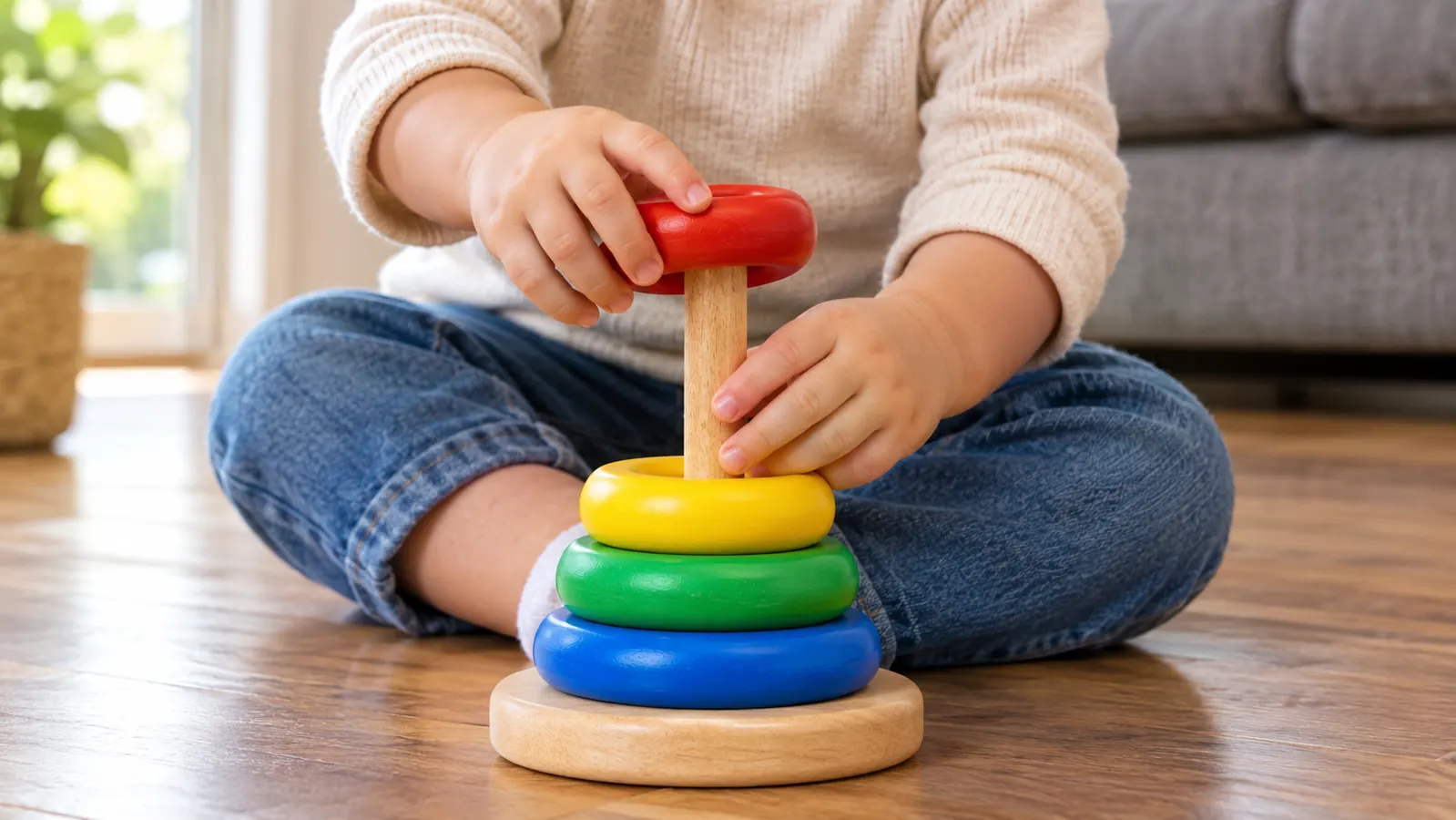
The base rocks. That is right there in the product description and you read straight past it, the way I did. In practice it means the whole stack sways while a toddler is trying to add a ring, and that changes everything about how hard the toy is. A fixed post is a simple hand-eye task. A rocking post is a hand-eye task plus a balance problem, and a two-year-old has to solve both at the same time with hands that are not fully under his control yet.
I think this is the best thing about it and also the reason some children walk away from it. Owen got frustrated around two years and one month and did not touch it for about three weeks. Then he came back to it and something had clicked. He had worked out that if he held the base steady with one hand and pushed the ring down with the other, it stayed put. That is a real problem-solving step and I watched him take it. A toy with a fixed post would never have handed him that lesson.
For a while I tried to make it easier on him, which was a mistake. I folded a washcloth and wedged it under one side of the base so the rocking stopped, and that worked for about a day. Then he pulled the cloth out, because a two-year-old finds anything tucked under a toy more interesting than the toy itself, and we were back to rocking with a wet washcloth on the rug. In hindsight I was solving a problem he needed to solve himself, and I should have left it alone from the start.
But if you have a child who gives up the first time something wobbles, this will sit on the shelf and gather dust. I would not buy it as a first stacking toy for a child who is easily frustrated. Buy it when they have already had some success stacking on something steady and they are ready for a harder version of the same job.
The Part I Checked Twice
I spent thirty-four years as a labor and delivery nurse, so I handle a new toy the way I used to handle equipment. I turn it over. I run my thumb along every edge. I check what comes off and what stays put. The Melissa & Doug listing says the pieces are smooth and easy to grasp, and that matches what my hands found. The rings are finished on both faces, the base has no corner I would call sharp, and there is no battery door to worry about because there are no batteries.
The rod is solid wood and it is fixed into the base. It does not come out when a child pulls at it, and Owen pulled at it hard. That matters to me more than any claim on the front of the box. A loose post on a toddler toy is the kind of thing that ends a Saturday at urgent care, and this one is not going anywhere.
The rings are graded, largest to smallest, so a child learns to compare before he learns to stack. One Tuesday in March Owen forced a big ring down over a small one and got it stuck partway, and I had to work it back up by hand. Before I did, I ran my thumb around the inside of the ring where the wood meets the rod, checking for a splinter or a rough cut. There was none on that ring and none on the two I checked after it. That is the sort of thing I look for, and it passed.
My one note for a house with a mouthing child is about the topper. It is a separate piece, and Owen is a child who puts everything in his mouth. I do not leave the topper where he can reach it unsupervised, and when the toy goes back in the closet I count pieces. That is a habit from my working life more than a criticism of the toy, but a grandmother should know going in that the topper lifts off and does not attach to anything.
How It Has Held Up
A little over a year in, this thing looks close to new. There is one small mark on the base from the tile floor. The rings have no chips I can find and no finish lifting at the edges, which is the first place a cheaper wooden toy gives out. I have wiped it down with a damp cloth more times than I can count with three children in and out of this house, and it has not raised a grain or gone dull.
It weighs about a third of a kilogram, so it is light, and light is the right call here. Owen carries it from the closet to the rug by himself and he is not a big two-year-old. A heavier wooden stacker would be a nicer object to hold and a worse toy, because the child could not move it on his own and would have to ask me every time.
The honest limit on durability is not the wood. It is how many times it gets thrown. Ours went down the porch steps once, by a child who shall remain Mason, and it survived without a mark I could find. I would not count on that forever. But this is the kind of toy that gets handed down rather than replaced, and I would not be surprised if it outlasts me.
Storage is simpler than I expected, which I appreciate more than I used to. Everything goes into a cloth bag on the low shelf in the spare bedroom, and the whole thing takes up about as much room as a loaf of bread. When I put it away I count nine pieces: seven rings, the topper, and the base. I have never come up one short after a weekend, and that says something about the size of the parts. Small pieces get lost in this house. These get found.
What I Liked
- Solid wood throughout, and the rod is fixed into the base so nothing works loose
- The rocking base turns a plain stack into a balance problem a toddler can actually solve
- No batteries, no sound, no screen, and nothing to charge or forget
- Survived drops on a tile floor and one trip down the porch steps
- Light enough at about a third of a kilogram for a two-year-old to carry it himself
Where It Falls Short
- The rocking base frustrates some children and there is no way to lock it steady
- Short play sessions, not long ones. Ten minutes is a good stretch
- The topper is a separate piece that lifts off, which matters in a house with a mouther
- It tops out around age three. My five-year-old has no interest at all
- Not a gift that gets a reaction when it comes out of the paper
Ten minutes a day, several times a day, for two years, is worth more than an hour of anything with a battery in it.
What My Older Grandchildren Do With It
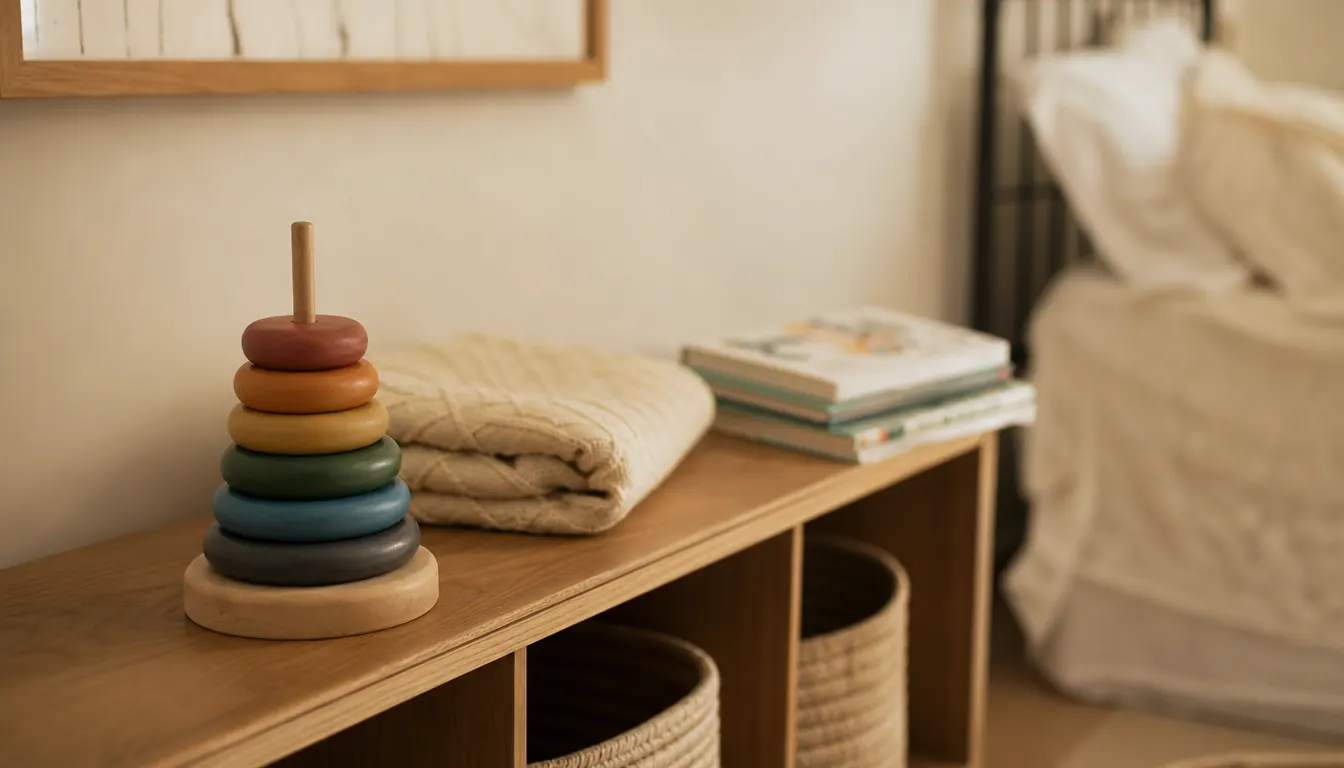
Ellie is seven and she has no interest in stacking rings. She does borrow them. She sorts them by size for a craft project, traces circles with them, and once built a very elaborate tower out of the rings and a roll of tape. Mason is five and will knock a finished stack down for about ninety seconds before going to find a ball. Neither of them is the target child and neither of them is harmed by having it in the house.
This matters for a grandparent because a lot of us buy one toy and quietly hope it covers every child who comes through the door. This one covers the youngest and barely touches the older two. If you are shopping for a five-year-old, this is not the gift. If you are shopping for a two-year-old and the older siblings will be in the same room, that is fine. They will ignore it and nobody will fight over it, which in my house counts as a feature.
What I Would Tell You Standing in the Toy Aisle
There are two kinds of wooden stacking toys and the difference is the base. A flat base with a fixed post is easier for a young toddler and teaches size order. A rocking base is harder and teaches size order plus balance. The Melissa & Doug Rainbow Stacker is the second kind, so buy it a few months after the first kind rather than instead of it. If you are choosing between them for a child who has never stacked anything at all, choose steady, and come back to this one later.
The second thing I would say is about the box. This is not a toy that sells itself when it is opened. It needs an adult to sit down and start it. Owen ignored it for most of the first week until I got on the rug and started stacking rings myself, badly, and then he came over to correct me. That is how this toy gets used, every time. If you are buying it to hand over at a party and walk away, you are buying the wrong thing, and the child will know it before you do.
Who This Is For
Buy this for a child between eighteen months and about three, and buy it for the house where that child spends real time. It is a grandmother's-house toy, not a birthday party toy. It rewards an adult who will get down on the floor, hand rings over, name sizes, and count out loud. It suits a family that would rather not have another thing that beeps in the living room. And it suits a grandparent who wants one wooden toy that will still be here, in one piece, when the next baby comes along.
Who Should Skip It
Skip it if the child is already past three and stacking with no trouble, because there is nothing here for them. Skip it if the child is easily frustrated by wobbling and has not yet had a win on a steady post. Skip it if you are after the gift that gets a shriek when the paper comes off, because seven wooden rings do not produce a shriek. And skip it if you want a toy that buys you twenty quiet minutes to yourself, because this one buys you ten noisy ones with you sitting on the floor. That is a fair trade for me. It is not a fair trade for everybody, and you should decide that before you buy rather than after.
One wooden toy a two-year-old can carry, stack, and drop
Seven rings, a topper, a rocking base, and a fixed wood rod. No batteries. It has lived in my house for a year with three grandchildren and it still gets picked up. If you have a child in the window, this is a sensible thing to buy.
Amazon Check Today's Price on Amazon →