
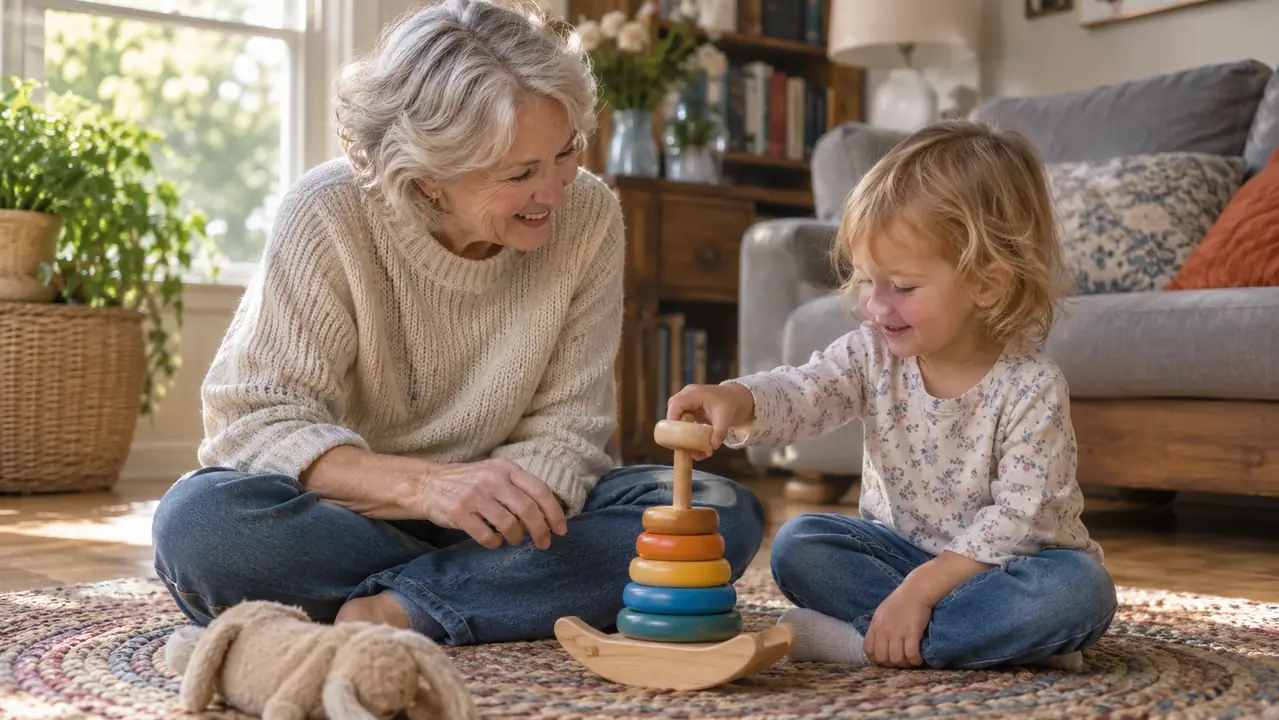
I keep a small shelf of toys in the spare bedroom for when the grandkids visit, and the rule for that shelf is short. Nothing that needs batteries. Nothing that comes apart into forty pieces I will be crawling under the couch to find. What is left is a short list of things that survive three children, and the Melissa & Doug Rainbow Stacker has been on that shelf longer than anything else on it.
Owen is two, the youngest of my three grandchildren, and he is the reason the shelf rule exists. Everything he picks up goes to his mouth first and gets examined later. I spent thirty-four years as a labor and delivery nurse before I retired, so I look at a toy the way I used to look at anything that came near a newborn. Small parts, sharp edges, hinges, battery doors, anything that could come loose under a determined jaw. The Rainbow Stacker passed that look before it ever came through my front door, and it has been in near weekly use for about a year now.
The Quick Verdict
Seven wooden rings on a rocking base, no batteries, no screen. It teaches size order at the pace a two-year-old sets and it has survived a year of being chewed, dropped and sat on. The topper goes missing and the base tips.
Amazon Check Today's Price →A Year on My Grandkids' Shelf and It Still Comes Out Every Visit
Seven wooden rings, a rocking base, and nothing to charge. This is the stacker Owen reaches for before anything noisy in the basket.
Amazon Check Today's Price on Amazon →How I've Used It
The stacker came into our house when Owen was about eighteen months old, which is the bottom of the age range printed on the box. At that age he did one thing with it. He took the rings off. He would pull them off one at a time, hand a few to me, drop the rest, and move on. That went on for weeks, and I will admit I wondered whether I had bought a toy he would never actually stack.
Then somewhere past his second birthday, something clicked. He started putting them back on. Not in order at first, and not always right way up, but on. He would get four rings up the rod, watch the whole thing lean, and push it straight again with both hands. The first time he got all seven on and set the topper on top, he looked at me like he had landed something on the moon. I have watched three children reach that same small milestone and it never gets old. That day was a Tuesday in the spring, the back door was open, and Ray was out in the garage, so I was the only one in the room to see it. I clapped and he clapped back at himself, which is the most two-year-old thing there is.
That is how it goes with this toy. It is not a toy that holds a child for an hour. It holds him for ten or fifteen minutes at a stretch, several times a day, and he comes back to it on his own without me suggesting it. Ellie, who is seven, still picks it up now and then, though she is really past it. Mason, at five, is out the back door before I can get the lid off the basket. This one belongs to Owen for now, and it will be here when he is done with it. I did try keeping it in a lidded plastic bin with a rope handle at first, thinking he would carry the toy around the house. He carried the bin and ignored the toy for the better part of a month. The open shelf works better. He can see it and reach it, and that is all a two-year-old really needs.
What Comes in the Box
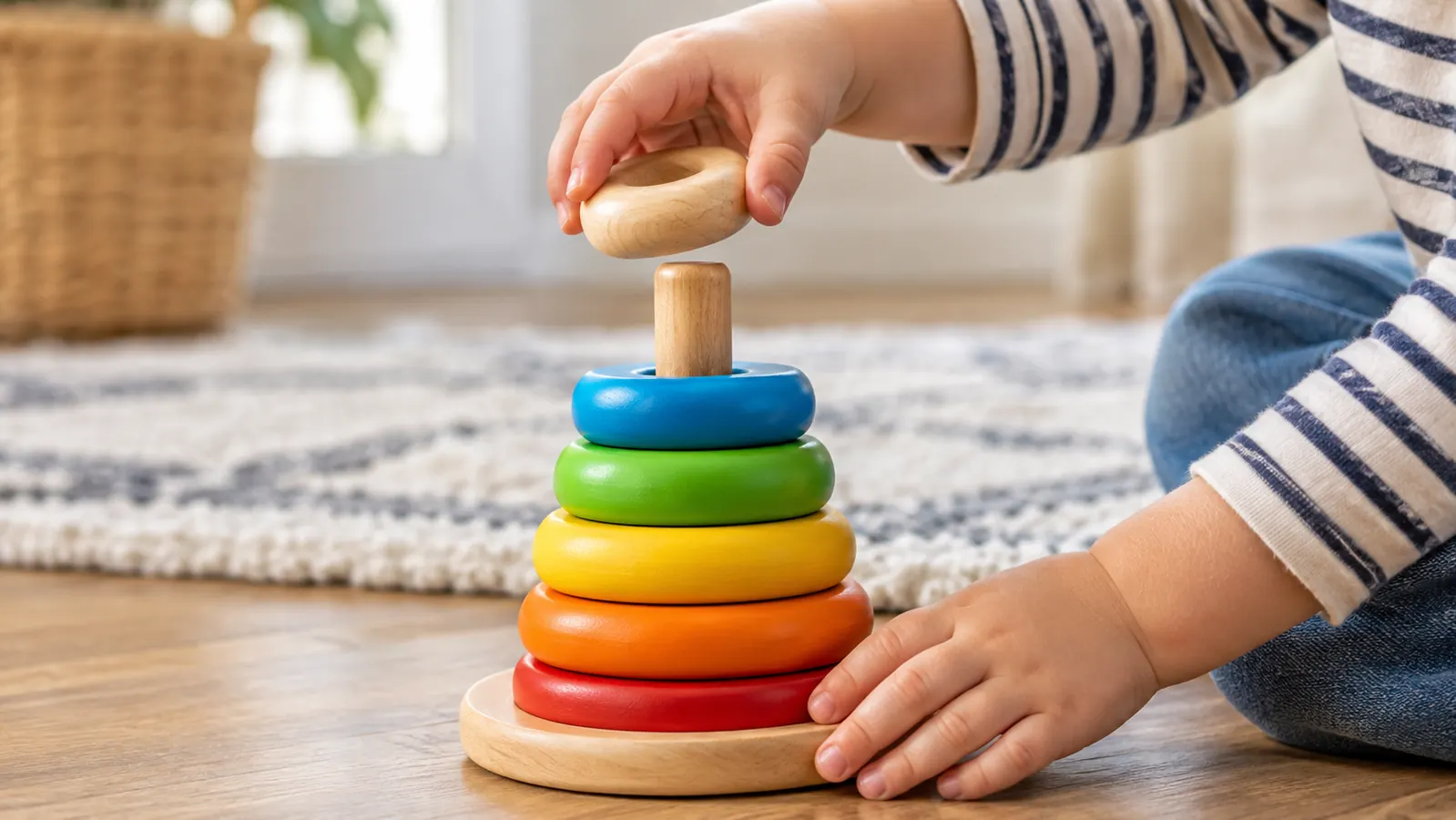
Seven rings, a topper piece, a wooden rod, and a rocking base. That is the entire toy, and I mean that as a compliment. There is no sound chip, no light, no battery compartment to open with a tiny screwdriver and then forget to close again. The Melissa & Doug pieces are wood and smooth to the hand, and the listing puts the whole thing at 0.36 kg, light enough that Owen carries it around by the base with one hand while he is walking.
The rings graduate in size, which is the working part of the toy. A child has to notice that one ring is bigger than the next and that the big ones have to go on first if the little ones are going to fit at the end. That is not obvious to a two-year-old. It takes a while, and the toy gives him a reason to work it out himself instead of being told.
Because the pieces are wood, they feel like something in the hand. They have a little weight to them, and they knock against each other with a sound I can live with. I have had plastic stackers in this house that I could hear from the next room and did not want to. This one I can listen to all afternoon on a Saturday while I am folding laundry, and that counts for more than I would have guessed before I had grandchildren.
The Rocking Base and Why It Changes the Toy
I did not think much about the base when I ordered it. A stacker is a stacker, and I had seen plenty of them with a flat board on the bottom. This one rocks, and that turns out to matter more than I expected. The child has to hold the rod steady with one hand while the other hand places the ring, because the base will not sit still on its own. That is a two-handed job. For a two-year-old who is still figuring out that his hands can do different things at the same time, it is real work.
The tradeoff is that it tips. When Owen leans on the top ring to push it down, the whole thing goes over, and he gets frustrated. He is learning to push straight down instead of sideways, but it took a few weeks and a few tears. A flat base would not have taught him that. It also would not have knocked over nearly so often. I think the rocking earns its place, but I understand why a grandparent in a hurry might feel differently on a bad afternoon. I counted it once, on a Saturday morning before breakfast, mostly out of curiosity. He got all seven rings on in about four minutes and knocked the thing over eleven times in the twenty minutes after that. That is not a flaw in the toy. That is the toy doing exactly what it was built to do, and it is also why I keep it on the shelf and not out on the rug where I will find it in the dark with my bare foot.
What Owen Is Actually Learning
The box says color recognition, and that is fair, though it undersells the toy. What I watch him work on is size. He has to compare two rings, decide which is bigger, and then act on it. That is the same mental move he will use later for numbers, and it is happening in his hands before it happens in his head. He is also using both hands together, one to steady and one to place, which is the skill that shows up later in buttons, zippers and holding a crayon.
There is a language piece too, and it happened without me planning it. We talk while he stacks. Bigger, smaller, on top, next one, all the way up. Nothing formal, just me saying out loud what he is already doing. He has started saying big and little on his own when he picks up the rings, and I do not think that is a coincidence.
And then there is the knocking down, which is the part he loves most. He builds it up and sweeps it flat with one arm and laughs. I used to think that was him being destructive. It is not. He is learning what happens when he does something, and he is learning it over and over, which is how two-year-olds learn anything worth knowing.
How It Has Held Up
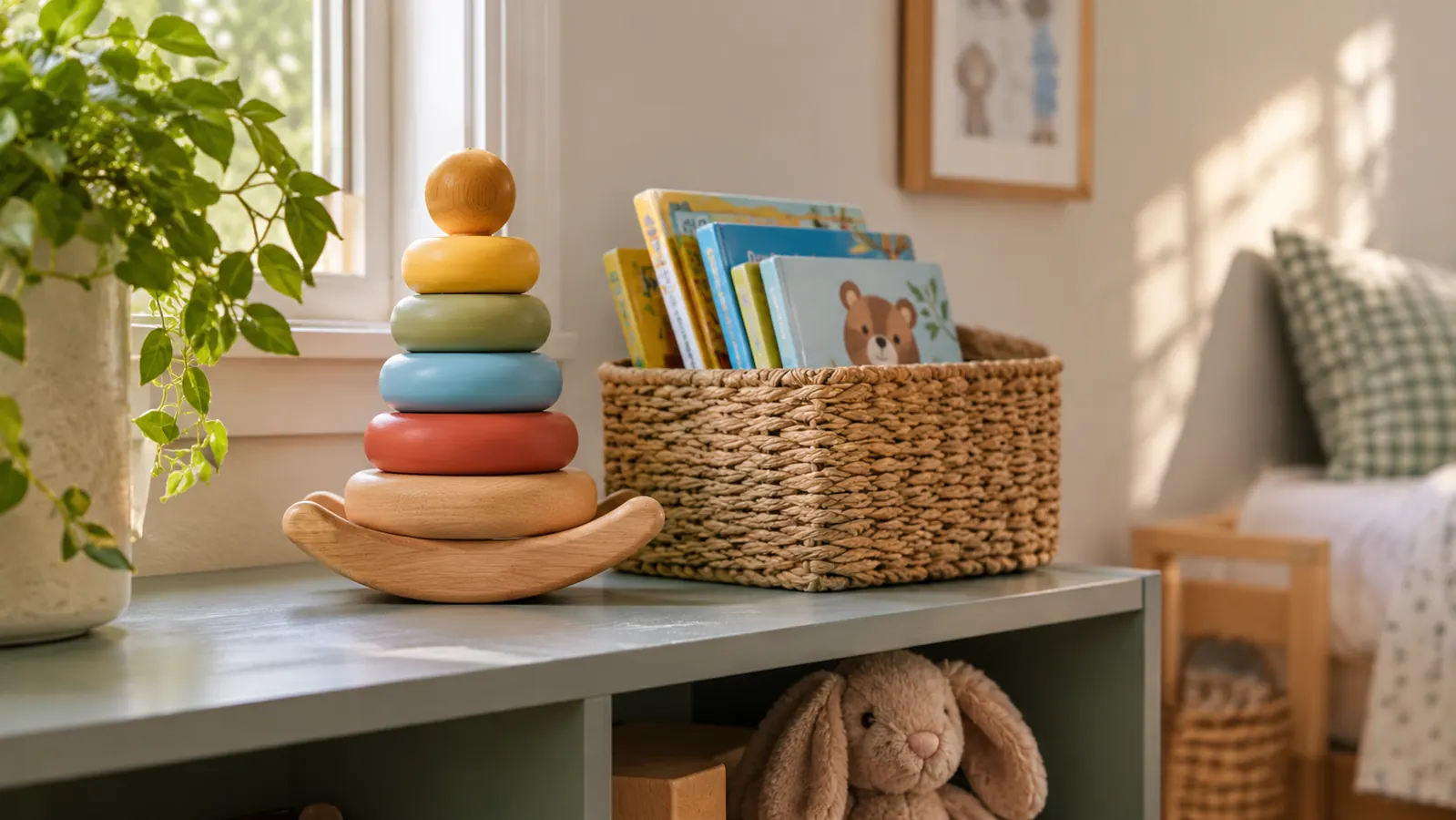
A year in, the top ring has a few teeth marks on it. That is what happens when a child is cutting molars and the toy is the closest thing at hand. The wood has not splintered. No ring has cracked. The rod is still tight in the base, and I have not had to take a screwdriver to anything. The marks came in the summer, right around the time he turned two and the back teeth started coming through. There are three of them on the top ring, shallow enough that I can feel them with a fingertip but they have not caught on a washcloth. That was the test I cared about.
It does get dropped on a wood floor, and one corner of the base has a small dent from that. It is cosmetic, and it has not turned into a rough edge, which was my worry, because a splinter on a toy that goes into a mouth is a real problem. I wipe the pieces with a damp cloth when they need it and dry them straight away. I do not soak them, and I would not put them in a dishwasher.
What It Does Not Do
It is not a building toy. Owen cannot make a house or a ramp or a tower that stands on its own, because the rings only go on the rod and the rod only holds so much. If your grandchild is the sort who builds and knocks down and builds again, a plain set of wooden blocks will get more use, and I have written about how those two toys split the job. I would not try to make this one do work it was not built for.
The topper is the other weak spot. It is small, it rolls, and it has gone missing twice in our house. Once under the couch and once into the bottom of the toy basket. It turned up both times. A house with a dog would lose it for good. The manufacturer's age range starts at eighteen months, and I take that seriously. When there is a younger baby crawling around, the whole toy goes up on the shelf and comes down for Owen only.
The last thing it does not do is correct him. There is no click, no chime, no voice telling him he got it right. Some children want that feedback and lose interest without it. Owen does not seem to need it, but I have seen children who do, and if yours is one of them, this toy will sit in the basket while the noisy one gets all the attention.
What I Liked
- Seven wooden rings and a rocking base, no batteries and no screen
- The rocking base forces two hands, which is real coordination practice
- Survived a year of chewing, dropping and being sat on with no splintering
- Graduated ring sizes give a genuine size-order lesson
- Quiet. It knocks softly instead of beeping
Where It Falls Short
- The rocking base tips when a child leans on the top ring
- The topper is small and gets lost
- Not a building toy, so a builder will outgrow it fast
- Teeth marks show on the wood and there is no way around that
He took the rings off for weeks before he ever put one back on. The taking apart is the lesson. The stacking comes later.
Who This Is For
This is for a child between eighteen months and about three who is learning to use two hands together and who does not need a screen to stay interested. It suits a grandparent's house especially well. It is quiet, it fits in a basket, and it does not require batteries you will forget to buy. It also suits a child in the take-it-apart phase, the one who disassembles everything he touches, because this toy is supposed to come apart. He can pull it down and build it back and pull it down again and nobody has to tell him no.
It is a good first birthday gift for the right family, provided the parents are happy to wait a few months before it gets real use. The Melissa & Doug version is the one I would buy again, not because it is fancy but because it has taken a beating in my house and still works. I have bought cheaper stackers for the church nursery, and they did not make it a year. These rings have kept their shape and their smooth finish. If you are weighing it against other stacking toys, the reasons stacking toys suit toddlers at this age come down to exactly what I have described. Two hands, size order, and a thing that comes apart on purpose.
Who Should Skip It
Skip it if your grandchild is a builder. Mason would have looked at this once and gone back outside to dig. A child who wants to make walls and towers and garages needs blocks, and there is nothing wrong with that. This is an ordering toy, not a construction toy, and pretending otherwise will just leave it sitting in the basket while he waits for something better.
Skip it too if there is a baby in the house who is still putting everything in his mouth and you do not want one more thing to supervise. The age range starts at eighteen months for a reason. You can do what I do and keep it on a high shelf for the older child, but if that sounds like one more job on a long list, wait a year. It will still be here, and so will the two-year-old.
If You Have a Two-Year-Old Who Takes Everything Apart, Start Here
Seven wooden rings, a rocking base, wood instead of plastic, and nothing to charge. A year in, it has earned its spot on my shelf.
Amazon Check Today's Price on Amazon →