
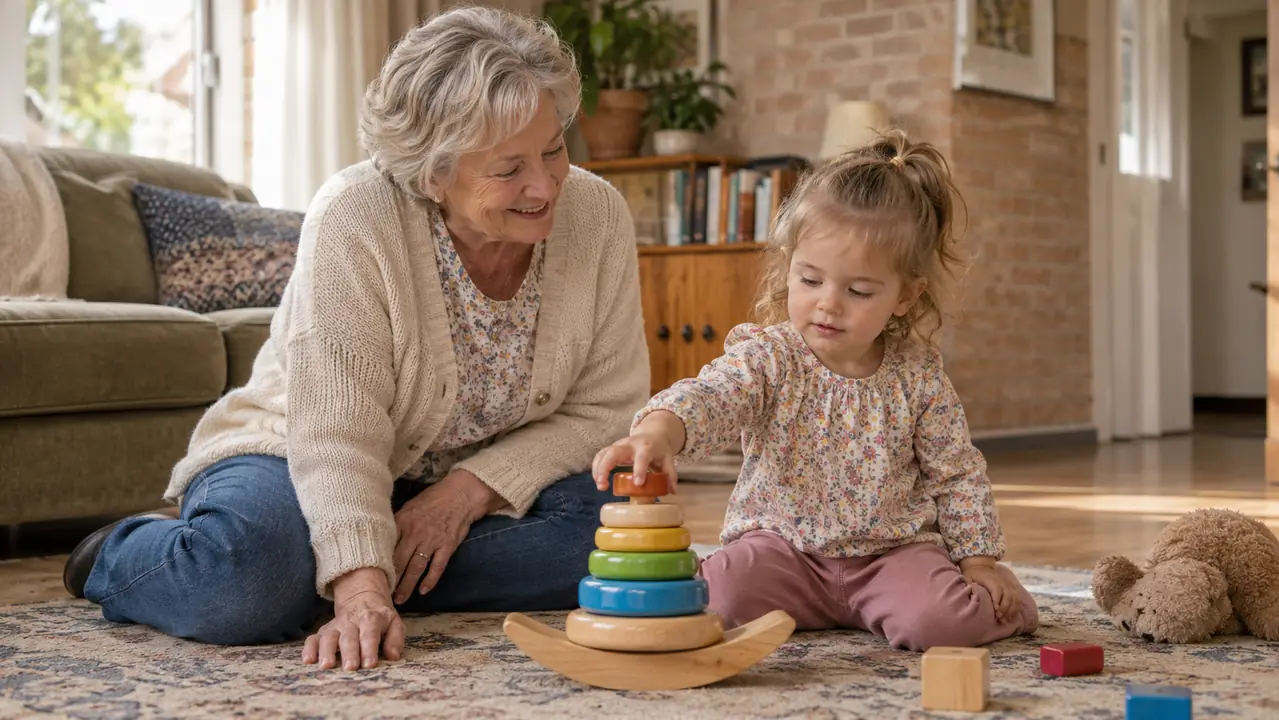
Owen is two. He visits most weekends, and the first thing he does is walk the living room looking for something to pick up, turn over, and put in his mouth. That is the stage. When my daughter asked what to get him for his birthday, I did what I always do. I watched what he actually did with a toy, not what the box promised. The Melissa & Doug Rainbow Stacker is the toy I would hand a two-year-old first. Classic wooden blocks are the toy I would hand the same child six months later, or hand to his five-year-old brother right now. If you want one clear answer, the stacker is the better first toy for a toddler grandchild. Blocks are the better long-term toy.
Here is the short version. The Melissa & Doug Rainbow Stacker gives a two-year-old one job he can finish: put the rings on the base. Wooden blocks give him a pile of possibilities, which is wonderful for a four-year-old and a little formless for a child who is still learning to place one object on another. I keep both in the spare bedroom. But if I had to choose one for Owen at his age, I would choose the stacker. The rest of this piece explains where each one earns its place, including the places where blocks win.
| Melissa & Doug Rainbow Stacker | Classic Wooden Blocks | |
|---|---|---|
| Recommended age | 18 months to 3 years, which fits a two-year-old | Varies by set, so you have to check the label |
| First stacking success | Seven rings and a topper give a clear goal on a rocking base | A child can build, but nothing tells him which piece comes next |
| Open-ended play | Mostly one job: stack the rings | Towers, roads, garages, pretend cakes |
| Fine motor practice | Easy-to-grasp rings build grasp and release | Smaller blocks ask for more precise placement |
| Longevity | Best from 18 months to 3 years | Useful into preschool and early school years |
| Pieces to manage | Seven rings, one topper, one base | Sets vary, often many pieces to gather |
| Battery check | No batteries required | No batteries in a plain wooden set |
| Building and balance | Stacking only | Balance, spans, ramps, towers |
| Cleanup with a toddler | Rings go back on the base in seconds | Loose blocks end up under furniture |
| Safety check for a mouthy two-year-old | Smooth pieces, no battery door, age label 18 months to 3 years | Depends on block size; small pieces need to stay in the bin |
Where the Rainbow Stacker Wins
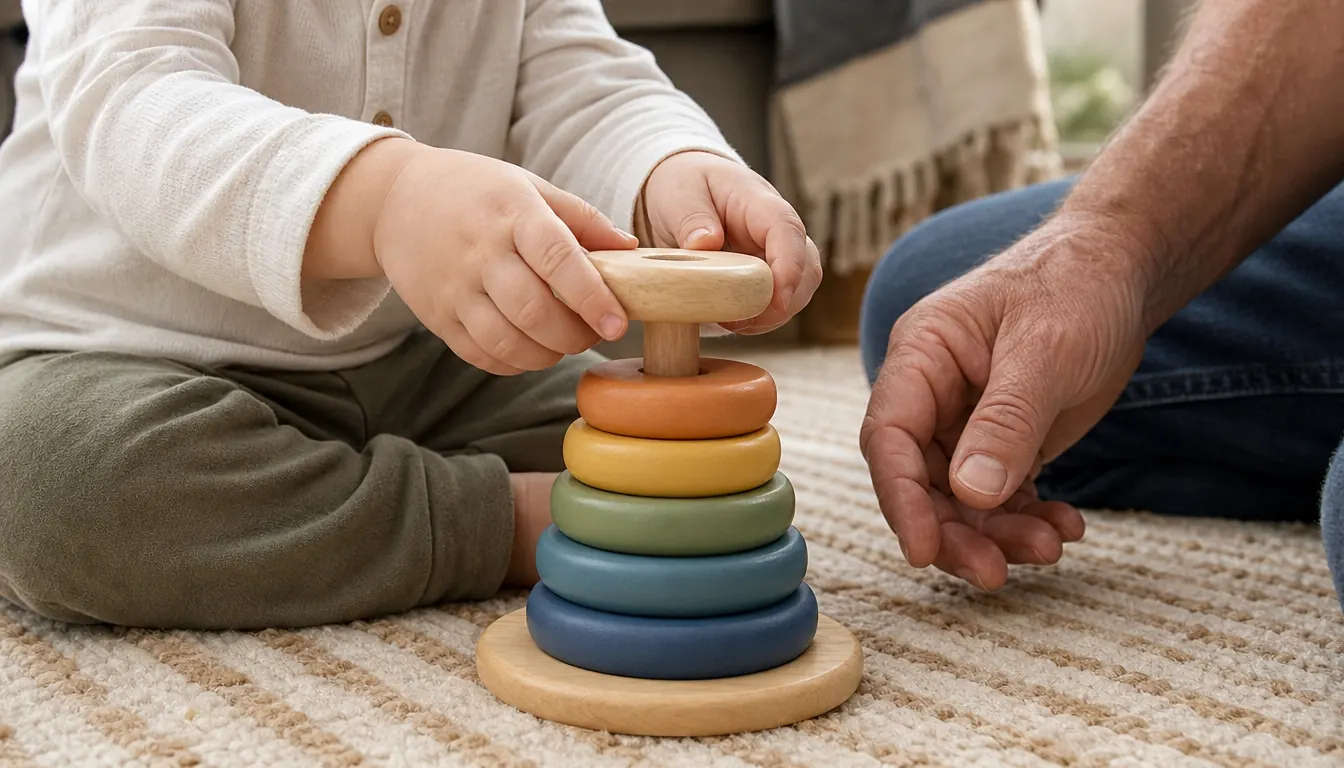
The first thing I look at is the age label. The Rainbow Stacker is listed for 18 months to 3 years, which is exactly where Owen sits. The set has seven rings, a topper, and a solid wood rod on a rocking base. The pieces are smooth and easy to grasp, which matters for a child who is still working on releasing an object on purpose. There are no batteries and no battery door to check. For a first stacking toy, that simplicity is the point.
It also gives him one skill at a time. The rings are different sizes, so he has to notice which one fits next. The listing names color recognition and size differentiation, and that is what I see: he sorts, tries, misses, and tries again. A pile of blocks does not tell him which piece comes next. The stacker does. That single clear goal is why a two-year-old will stay with it longer than you expect.
Where Wooden Blocks Win
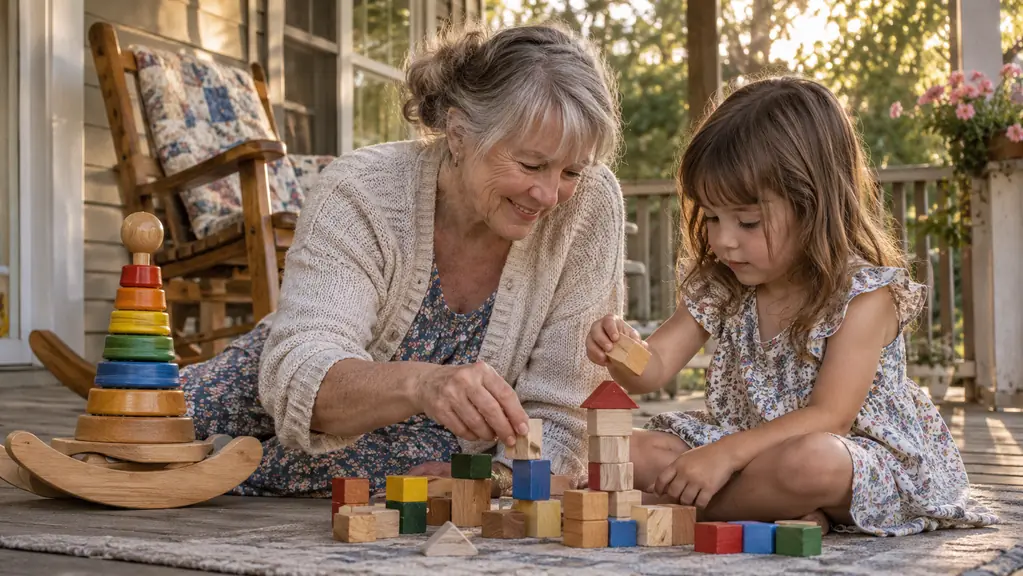
Wooden blocks win on possibility. A block can be a tower, a road, a garage, a pretend cake, or a wall for a stuffed animal. Owen's older brother Mason can build a tower and Owen can knock it down, and both of them are getting something out of it. Blocks also last. A good set moves from toddler stacking to preschool building to early school projects. The stacker has a narrower window. One afternoon this spring, Mason built a garage with a ramp and sent a toy truck down it. Owen watched the whole build, then flattened it with one hand. Both of them thought that was the best thing that happened all day. The stacker cannot do that.
Blocks also ask for more from the child. He has to balance one piece on another, line up edges, and decide what he is making. That is real thinking. The tradeoff is that a pile of blocks can be too open for a two-year-old who still puts things in his mouth. You have to check the size of the pieces and keep the small ones off the floor when Owen is around. Blocks are the better family toy. They are not always the better first toy.
If You Want the First Toy, Start With the Stacker
It is the one I would put in Owen's hands at two. Seven rings, a topper, a rocking base, and no batteries to open. See the Melissa & Doug Rainbow Stacker on Amazon.
Amazon See the Rainbow Stacker on Amazon →How I Tested Both With Owen
I did not run a formal test. I put both toys on the living room rug on a Saturday morning and sat on the floor with him. The stacker came out first. I set the base down and put the rings in a loose pile beside it. I did not help unless he handed me a ring. He got the first two on by himself, missed the third, and tried again. That is the kind of small win I want from a first toy. Before either toy, I had tried a basket of plastic linking toys, the kind that snap together. Owen could pull them apart but could not push them back together, and after two minutes he was done and asking to go outside. That failure told me more about his stage than any age label did.
Then Ray brought in the blocks. Owen watched Mason build a tower, then knocked it down with both hands and laughed. He stacked two blocks, knocked them over, and went back to the stacker. That is not a scientific result, but it is a useful one. At two, he wanted the toy with a clear job. At five, Mason wanted the blocks. Same floor, same morning, different stages. Ray had left the blocks in a low bin Owen could reach, which I fixed the same afternoon. The bin moved to the top shelf of the porch cupboard, and I brought out eight large blocks at a time instead of the whole set.
I watched for the things I always watch for. Did the pieces come apart in a way they should not? Did he put anything in his mouth that was too small? Did the toy hold his attention for more than a minute? The stacker passed the first two checks without a fuss. The blocks passed when we kept the smaller pieces in the bin and put out the larger ones. That is not a knock on blocks. It is just what a house with a two-year-old requires.
Safety Details I Watch
I spent thirty-four years as a labor and delivery nurse, so I am not casual about small parts. I turn every toy over and read the age label. I check for sharp edges, loose pieces, and battery doors that a child can open. The Rainbow Stacker has no batteries, and the pieces are smooth and easy to grasp. The topper and the rings are the only loose pieces, and they are meant to come off. That is the toy.
With blocks, the check is different. You have to look at the size of each piece, not just the box. If a block is small enough to fit through a cardboard toilet paper tube, it is too small to leave on the floor with Owen. I keep an empty tube in a kitchen drawer for exactly that check. Anything that slides through it stays off the floor when Owen is awake. The larger blocks in a standard set pass. The small ones do not. I also check the finish for chips and the corners for rough spots. Wooden blocks are durable, but they are not indestructible. A block that has been chewed or dropped on the porch needs a look before it goes back in the bin.
The best first toy is not the one with the most pieces. It is the one a two-year-old can finish, then start again without help.
The Skill Each Toy Builds
The stacker builds a specific set of skills. A child has to grasp a ring, line it up with the rod, and let go at the right moment. That is fine motor control. He also has to notice size and color, which is early math and language. The listing names color recognition and size differentiation, and that matches what I see. It is not a toy that teaches letters or numbers. It teaches the hand and the eye to work together. The first time Owen got the smallest ring on by himself, he did not clap. He looked at it, then looked at me, then took it off and did it again. That repetition is the whole lesson.
Blocks build a different set. A child has to balance, align, and plan. He learns that a wide base holds more than a narrow one, and that a tower falls if he puts the big block on the small one. That is early engineering. Blocks also invite pretend play. A row of blocks becomes a train, a fence, or a birthday cake. The stacker is a stacking toy. Blocks are a system. Both are useful. They are not the same job.
What I Liked
- Clear first stacking goal for a two-year-old
- Smooth, easy-to-grasp wooden pieces
- Builds color recognition and size differentiation
- No batteries and no battery door to check
- Fits the 18 months to 3 years age range
Where It Falls Short
- Limited open-ended play next to blocks
- Most children move past it around age three
- Rings can be scattered around the room
- Not the toy for a child who wants to build castles
What I Would Not Do
I would not buy a large block set with tiny pieces and leave it on the floor with a two-year-old in the house. That is not a knock on blocks. It is a knock on the way we store them. I would also not buy the stacker for a four-year-old and expect it to hold him. The age label is there for a reason. A toy that is too young gets ignored. A toy that is too old gets used the wrong way. And I would not store the two toys in the same bin. I tried that for a week. The rings ended up mixed in with the blocks and the base went missing under the couch twice.
What About the Older Grandchildren?
Ellie is seven and Mason is five. They are past the stacker, mostly. Ellie will still sit with Owen and hand him rings, which is its own kind of play. Mason will build with blocks for an hour. That matters if you are buying one toy for a house with more than one child. The stacker is for Owen. The blocks are for the family. If you want a gift that gets used by everyone, blocks are the safer choice. If you want a gift that fits the two-year-old in front of you, the stacker is the one.
I still keep both. The stacker lives in the spare bedroom with the board books. The blocks live in a low bin on the porch, and that bin comes down off the shelf when an adult is on the floor with him. Owen can reach the stacker on his own. That is not a rule I wrote down. It is just what the toys ask for. A first toy should let a child succeed without a coach. A family toy should give everyone something to do.
Who Should Buy Which
Buy the Melissa & Doug Rainbow Stacker if the child is between 18 months and 3 years, if he still puts things in his mouth, and if you want one toy that gives him a clear job. It is also the better gift if you are shipping something to a house you do not visit often, because there are only seven rings, one topper, and one base to keep track of. It is not the toy for a four-year-old who wants to build a castle. It is the first toy.
Buy wooden blocks if the child is closer to three or four, if there are older siblings, or if you want a toy that will still be in use in two years. Look for a set with pieces large enough for the youngest child in the house. If you are buying for Owen now, you can still buy blocks. Just keep the small pieces in the bin and put out the larger ones when he is on the floor. The two toys are not in competition on the shelf. They are in competition for the same ten minutes of a toddler's attention.
My answer is the same as it was at the start. For a two-year-old grandchild, the stacker is the better first toy. For a family with a range of ages, blocks are the better long-term buy. If you can only give one, look at the child in front of you. Owen is two. He wants to finish something. The stacker lets him.
The First Toy Should Be the One He Can Finish
If you are buying for a toddler grandchild, start with the Melissa & Doug Rainbow Stacker. Seven rings, a topper, a rocking base, and no batteries. Then add blocks when he is ready to build.
Amazon See the Rainbow Stacker on Amazon →