
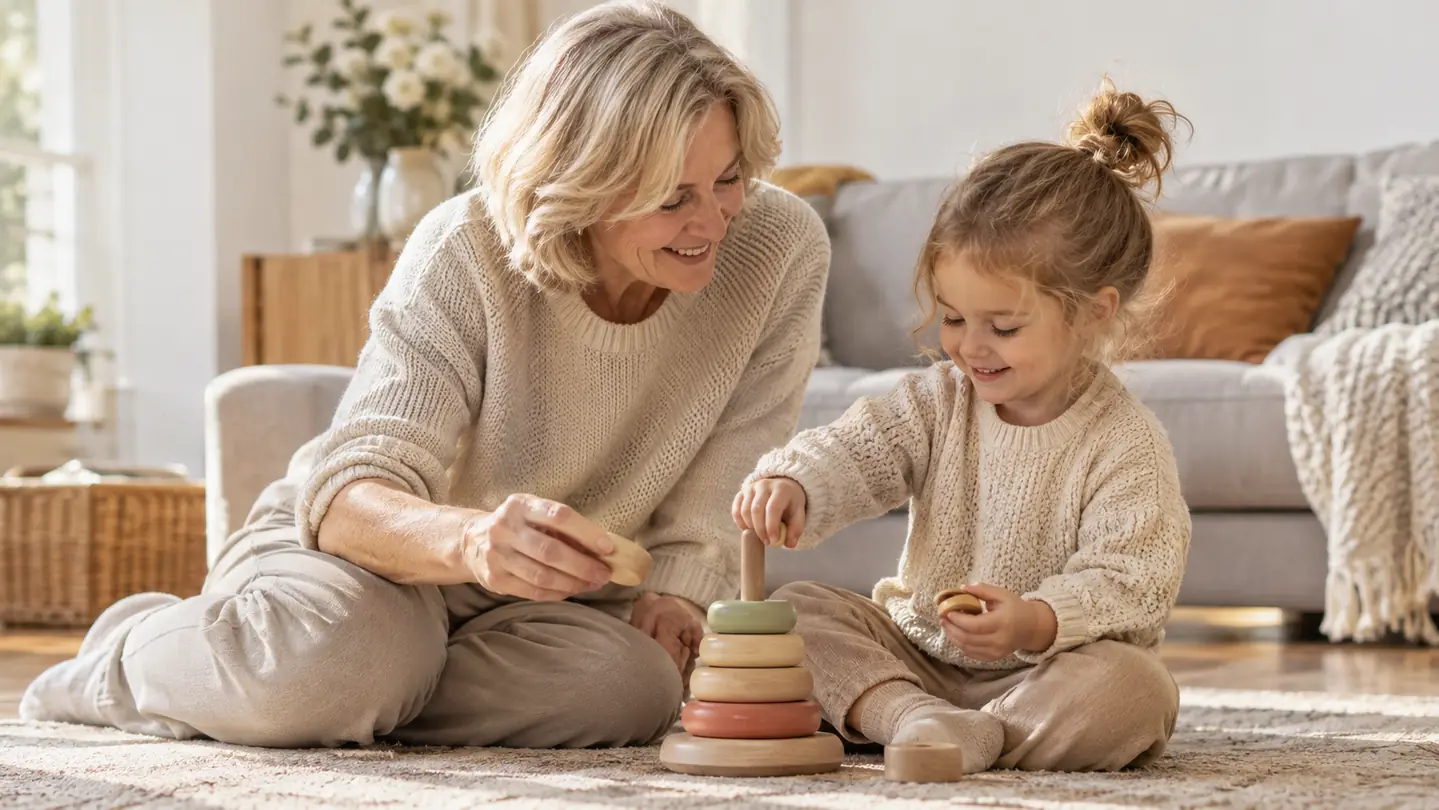
Owen is two. He has a room full of toys at my house and about a four-minute attention span for most of them. Last Saturday he pulled the Melissa & Doug Rainbow Stacker off the shelf, handed me a ring, and sat down on the rug. That was the whole invitation. I am June Pemberton, sixty-seven, a retired labor and delivery nurse, and I have learned that a toddler does not need a grown-up to teach him how to play. He needs a grown-up who will get on the floor and stay there. The stacking toy is a good excuse.
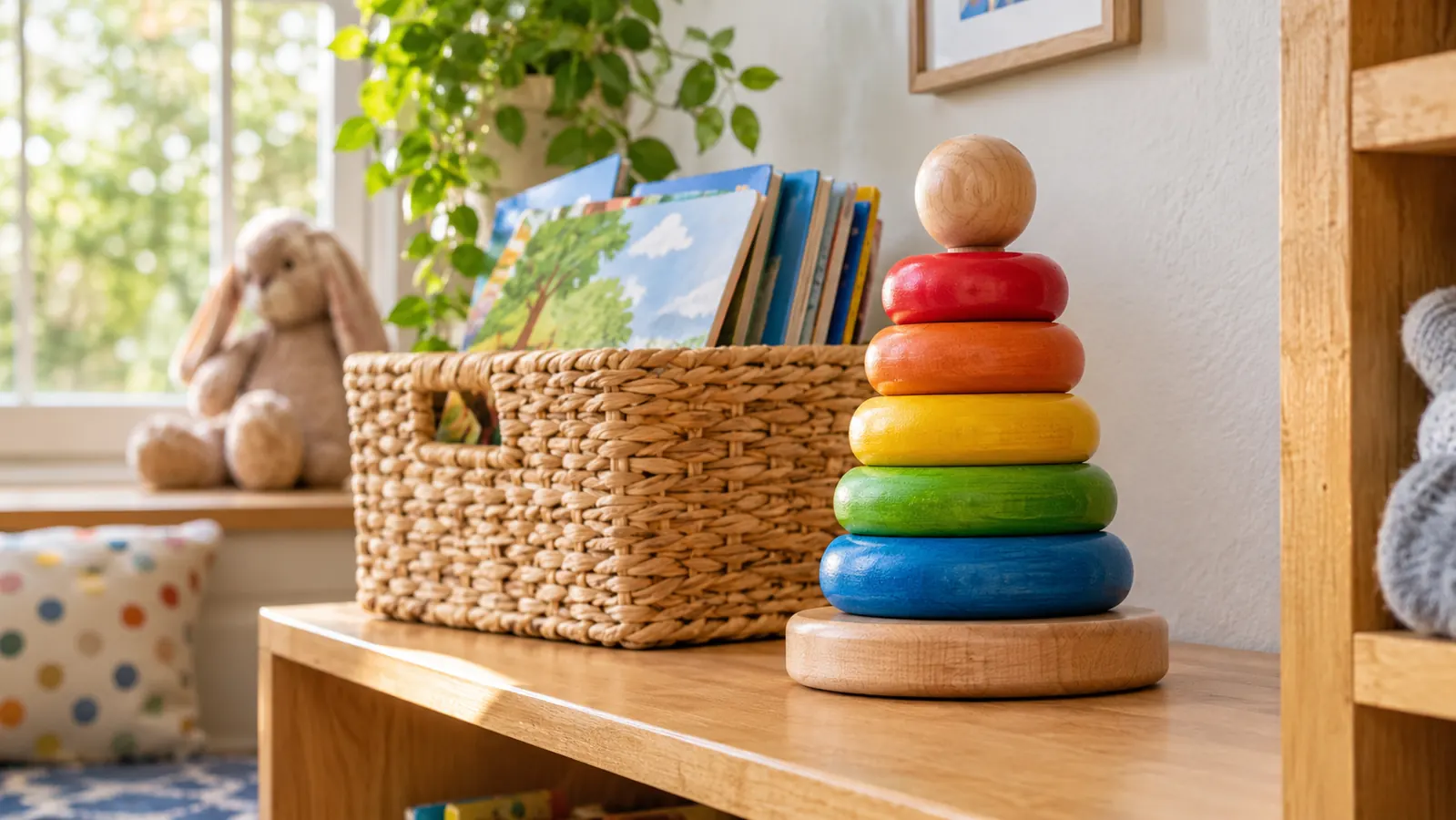
The Melissa & Doug Rainbow Stacker is simple by design: seven wooden rings, a topper piece, and a solid wood rocking base. No buttons, no batteries, nothing to charge. The box says eighteen months to three years, which fits Owen. He is right in the middle of that range now. What I have found over many weekends is that the toy works best when you stop treating it like a test. The point is not to get the rings in the right order. The point is to spend twenty minutes talking, handing pieces back and forth, and letting a small person feel like the one in charge. Here is how I do it.
A simple toy that gives you something to talk about
The Melissa & Doug Rainbow Stacker is the kind of toy that sits on the shelf until a child asks for it. Then it turns into a half hour on the floor. Seven rings, a topper, and a rocking base. No screens, no batteries, no setup.
Amazon See the Rainbow Stacker on Amazon →Step 1: Start with the pieces, not the stack
Dump the rings out between you. Not in a neat pile. Let them scatter. A toddler learns by picking things up, turning them over, and deciding what to do next. If the stack is already built, the play is over before it starts. I learned this the hard way with Ellie. She was about three, and I built a perfect tower before she even came into the room, thinking she would be impressed when she saw it. She looked at it, knocked it down with one hand, and went off to the kitchen. The tower was my play, not hers. I have not pre-built a stack since.
So now I start with the pieces. I set the base on the rug and put one ring in Owen's hand. Then I wait. I do not say 'put it on.' I do not guide his wrist. I let him look at the rod and the hole in the ring and figure out that one goes into the other. Sometimes he tries to put the ring on sideways. Sometimes he puts it on his head. That is fine. The first step is contact, not correctness.
If he hands the ring back to me, I take it and put it on the base slowly, so he can see the motion. Then I hand him another ring. That is the whole lesson. Back and forth, no commentary, no applause. He is learning with his hands, and he does not need a narrator yet.
Step 2: Let the toddler lead the first round
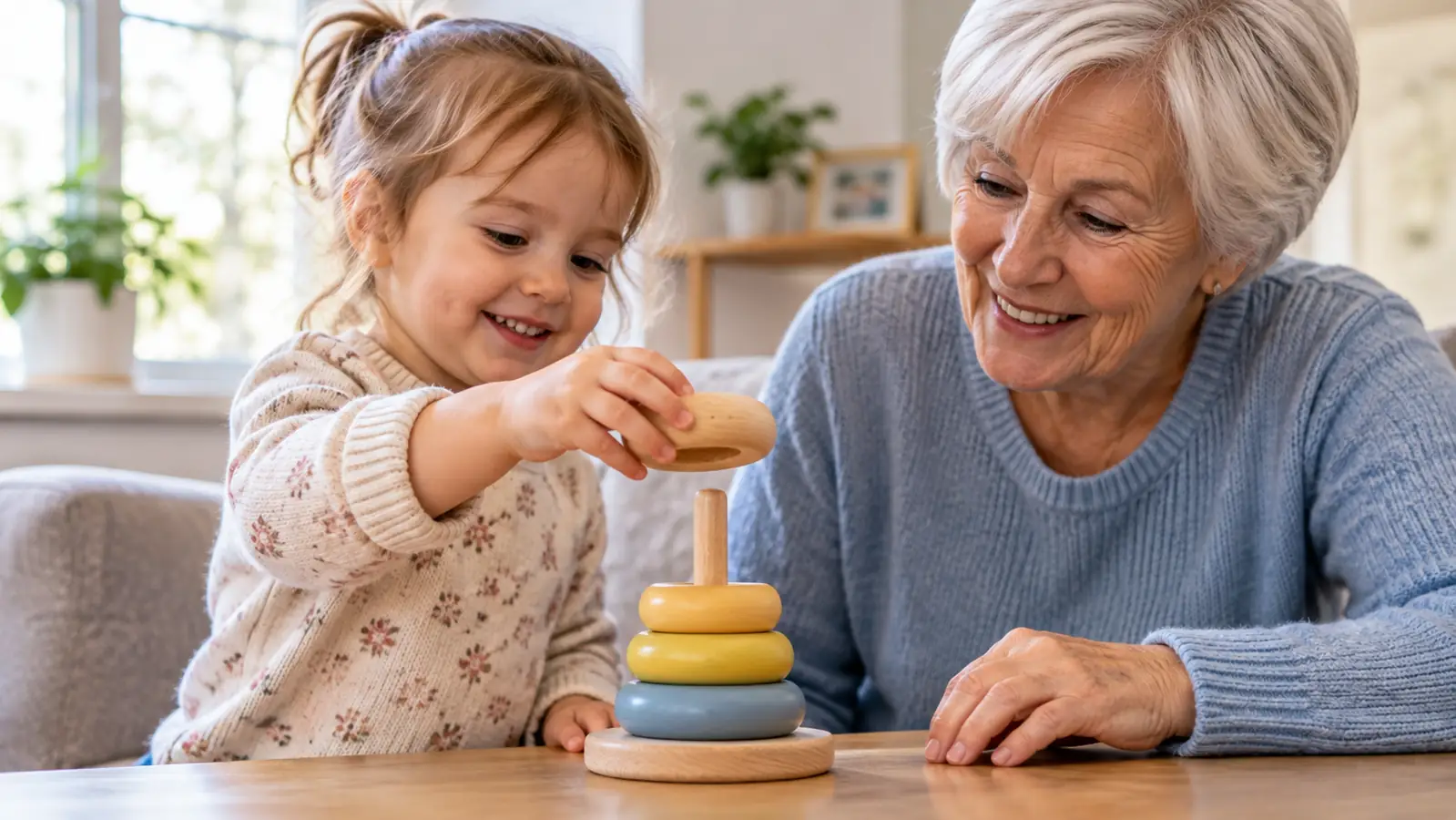
After the pieces are out, I stop talking for a minute. This is harder than it sounds. I am a grandmother. I like to narrate. But the best floor time I have had with Owen came on a wet Saturday in March, when the yard was too muddy to go out and we were stuck inside with the books and the stacker. I said nothing and let him choose the first ring. He picked one up, tried it on the rod, missed, turned it, and got it on. I watched. That was the whole first round.
When he looks at me, I say something short. 'You got it on.' Or 'That one is wobbly.' I do not say 'good job.' I am not against praise, but 'good job' ends a conversation. A specific observation keeps it going. He looks at the ring, then at me, then back at the ring. He is thinking. That is the point.
If he gets stuck, I do not solve it. I wait. If he starts to fuss, I offer one small move. 'Turn it.' Or I turn my own ring slowly so he can see the wrist motion. Then I hand it back. The goal is to keep him in the game, not to finish the stack for him. There is a fine line between helping and taking over, and I cross it more often than I like. When I do, he stops reaching for the rings. That is my signal to back off and put my hands in my lap.
Step 3: Name what you see, not what you want
A stacking toy is a vocabulary lesson if you let it be. The Melissa & Doug Rainbow Stacker has seven rings, and each one is a different size. That gives you words: bigger, smaller, wider, narrower, on, off, next, last. I use those words while we play, but I do not turn it into a quiz. I do not point at a ring and ask a question Owen cannot answer. He is two. He is more interested in the fit than the label.
Instead, I say what I notice. 'That one is wider than the last one.' 'This ring is stuck.' 'You put the small one on top.' He hears the words attached to the thing he is doing. That is how vocabulary sticks. It is also how he learns to compare sizes without a worksheet. The toy is doing the teaching. I am just the voice beside him.
I keep it to one or two words at a time. 'On.' 'Off.' 'Wobble.' If I say too much, he stops listening. The silence between the words is where he gets to try. If he repeats a word, I do not make a big deal of it. I just use it again later, and by the end of the afternoon he has said it three or four times without being asked.
Step 4: Add movement and sound
The rocking base is the part that keeps Owen interested after the stacking gets old. It is a solid wood base that rocks, so the stack is never completely still. He puts a ring on, the tower leans, he puts a hand out to steady it. That is a whole-body job for a two-year-old. The first time he tried it, he grabbed the rod instead of the base and the whole thing went over sideways. He looked at me to see whether that was allowed. I said 'it fell.' He laughed and did it again on purpose, four more times. Fine by me. Knock it down on purpose, then build it again. I do not grab the tower to keep it upright.
We also make it loud. Not chaos, just sound. When the stack falls, I say 'boom' in a flat voice. When it stays, I tap the base twice. He copies the tapping. Then he taps the rings. Then he taps my hand. The play moves from the toy to the floor to me and back. That is what you want. A toy that only works one way gets old fast.
I add movement for the bigger kids too. Mason is five, and he likes to build the stack as tall as he can and then knock it down. Ellie is seven, and she sorts the rings by size before she stacks them. They are playing with the same toy at different levels. Owen watches them and tries to copy. That is free instruction, and it is better than anything I could say.
Step 5: End before he is done
This is the step most adults skip. When Owen is still interested, I start to put the rings back in the basket. Not all at once. One at a time. I say 'one more, then we put it away.' He usually hands me the next ring. He is learning that play has a beginning and an end, and that the end is not a punishment. Owen does not say much yet, so I watch his hands more than his face. When he starts to set a ring down without trying it on the rod, that is the sign. The interest is going. That is when I start the countdown.
If I wait until he is bored, he walks away from the toy and I am left to clean up alone. If I stop while he is still engaged, he comes back to it next time. That is the whole trick. A toy that is put away before the child is done stays interesting. A toy that is abandoned on the floor becomes furniture.
I also use the cleanup as part of the play. He puts a ring in the basket, I say 'in.' He puts another one in, I say 'in' again. By the time the last ring is away, he has had a little lesson in counting and sorting without anyone saying 'now we are going to learn.' Then we go outside or read a book. The toy did its job.
What Else Helps
A few things make the floor time go better. First, get down on the floor. Not on the couch, not in a chair. A toddler plays at eye level. If I am above him, I am watching. If I am beside him, I am playing. Second, keep the toy where he can reach it. The Melissa & Doug Rainbow Stacker lives on a low shelf in the spare bedroom, next to the picture books. He can get it himself. That is important. A toy that requires an adult to lift it down is a toy that gets played with less.
Third, check the pieces. Wood holds up well, but it is not indestructible. I run my thumb over the rings and the rod every few weeks. Last fall I found a hairline split in one of the middle rings and put it in the bin that afternoon. Ray looked at it and said it probably would have held. I said probably is not good enough with a two-year-old in the house. If a piece has a rough edge or a crack, it goes. Owen still puts things in his mouth, so I do not leave him alone with any toy that has a loose part. The box says eighteen months to three years, and I follow that. I also keep the smaller rings out of reach if he is in a throwing mood. That is not a defect in the toy. That is a two-year-old.
Fourth, do not buy a second stacking toy to solve a problem you do not have. One good wooden stacker is enough. If you want to add something, add a basket of books or a set of blocks. The Melissa & Doug Rainbow Stacker does one thing well, and that is enough. The goal is not to fill the room. The goal is to give a child something worth coming back to.
One more thing. Ray and I keep a small basket by the back door with a few outside toys, and the stacker does not go in it. Wood and wet grass are not a good pair. The stacker stays inside, on the low shelf, where Owen can find it when he wants it. That small bit of order helps. He knows where it lives, and he knows he can ask for it. A toy that is easy to reach is a toy that gets used.
The point is not a perfect stack. The point is twenty minutes on the floor with a grown-up who is paying attention.
The toy that earns its place on the shelf
Seven wooden rings, a topper, and a rocking base. No batteries, no screens, no noise unless you make it. If you want a simple toy that gives a toddler something to do beside you, this is the one I keep within Owen's reach.
Amazon See the Rainbow Stacker on Amazon →