

I bought Spot It! Classic for my granddaughter's seventh birthday and then left it in the spare bedroom closet for three weeks. Not out of forgetfulness. I read the tin, saw six years and up, and decided to hold it back until she could play without me hovering over her shoulder. That is the honest start of this review. Asmodee sells a game that looks like a five-minute toss in the basket, and it turns out to need a little more thought than the packaging lets on.
Since then it has been on my kitchen table more weekends than I can count. Three grandchildren, two children from up the road, one husband who does not care to lose, and me with my reading glasses on. Nobody else read the rulebook. I read it twice. What follows is the part I wish someone had told me in the store aisle, including the parts that are not flattering to the game or to me.
The Quick Verdict
Genuinely good from about age seven up, and worth holding back if there is a two-year-old in the house. Loud, fast, and better at teaching a child to lose than any lecture I have given.
Amazon Check Today's Price →The game the grandkids ask for before the cookies are gone
Fifty-five cards, one rulebook, one tin, about ten minutes a round. Ours has been dropped on a brick patio, sat on, and packed for a week at the lake. It still plays.
Amazon Check Today's Price on Amazon →How I Actually Tested It
Ellie is seven and reads above her grade level. Mason is five and does not sit still for anything that does not involve a fence and a ball. Owen is two, and his contribution to game night is putting things in his mouth. Those three, plus Ray, plus whatever neighbor children wander over, are the test group. We played at the kitchen table, on the covered back porch, and once on a picnic blanket in the yard until the wind took a card halfway to the fence. I kept a tally on the back of an old grocery list for the first month, mostly because I wanted to say something true about how long a round actually runs instead of guessing at it.
My first attempt at a game night went badly. I set the tin on the table after supper, explained the rules from memory, and got two of them wrong. Ellie corrected me. Mason had already slid under the table with the dog. What fixed it was playing the shortest version in the rulebook for five minutes before supper instead of a full game after it. Small doses, before the meal, while everybody is still civil. That took me a month to work out and it is the single most useful thing in this review.
A round runs about ten minutes. That is not my estimate, it is what the set promises, and in my experience it is close to right. Which matters more than people without small children realize. Ten minutes is the honest outer limit of a five-year-old's attention, and a game that runs long is a game that ends in tears that have nothing to do with the score.
The whole thing rests on one idea. Every card shares exactly one symbol with every other card, and you race to be the person who names it first. There are no turns to wait for, no dice, no pieces to lose under the couch. I have sat through a great many children's games in thirty-four years as a labor and delivery nurse and then as a grandmother, and most of them ask a child to wait his turn while somebody else has the fun. This one does not. That single design choice is why Mason will play it and will not play anything with a spinner.
What Nobody Tells You About the Six and Up Label
Here is the thing the tin does not say. The age label is not about whether a child can spot the matching symbol. A five-year-old spots it faster than I do, and often faster than Ray, who will deny that to his grave. The label is about losing. Six is roughly the age where a child can lose a game in front of other people and come back for the next round without it ruining his afternoon.
Mason was five when we started. He found matches before anybody. He also threw a card across the porch the first three times he did not win. We worked through it, mostly by playing in pairs at the start so that nobody was alone in losing, and by the end of the summer he could lose with his chin up and ask for another round. That is a skill, and I will take a game that teaches it over a game that lets him win.
The other thing the label is quietly about is Owen. Two-year-olds mouth things, and cardstock cards are exactly the size and stiffness that a two-year-old will chew. We solved it by playing during his nap, or by parking him in Ray's lap with the tin lid to bang on, which is not part of the game but did keep the cards dry. If you have a toddler and you were planning to leave this on a low shelf, plan again.
Fifty-Five Cards, a Rulebook, and a Tin That Earns Its Keep
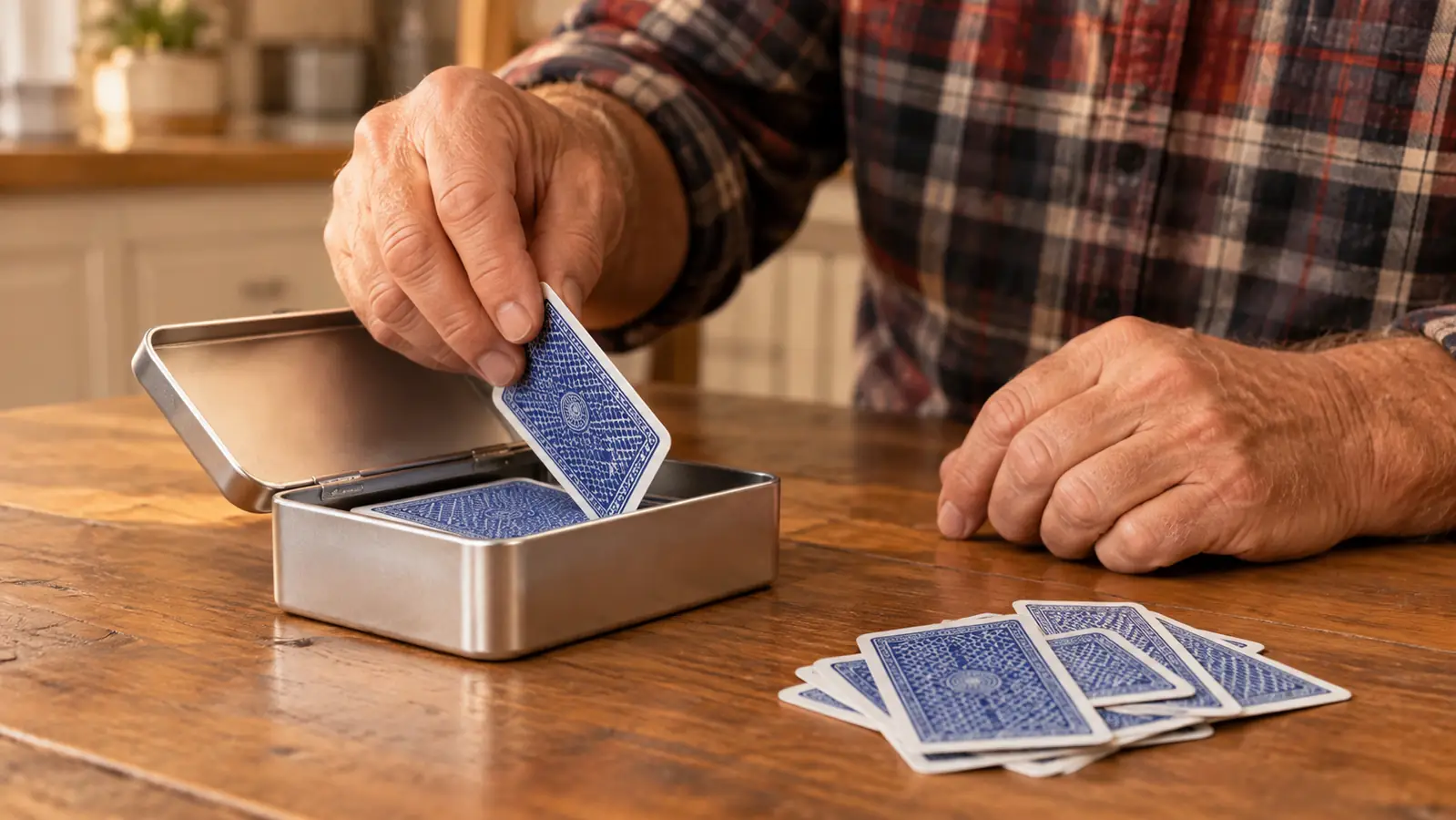
What you get is 55 cards, a rulebook, and a tin. The tin measures about 3.3 inches by 5.9 inches, small enough to sit in a glove box or a tote bag and large enough that the cards come out without a fight. Asmodee kept it simple: cards in the tin, lid on top, nothing else to lose. I have owned games that arrived in a cardboard box with an insert that shredded by the second weekend and never went back in correctly after that. This one has nothing to shred.
The size matters more than it sounds. I held the tin up against the paperback I keep in my purse and it is smaller. That means it went to the lake with us in a tote bag next to the sunscreen, and it went to a restaurant once when a meal ran long and a five-year-old was running out of patience. I have bought games that live in a closet because the box is the size of a shoebox and nobody wants to carry it. This one gets carried.
The cards are cardstock, and they have held up through a summer of being shuffled by children, dropped on brick, and stacked into a tower by a two-year-old. They are not indestructible. Two of ours have a bend in them from an enthusiastic shuffle, and one has a soft corner. They still play fine. The tin is what keeps the set from turning into 55 loose cards in a drawer, and that alone is worth more than it sounds.
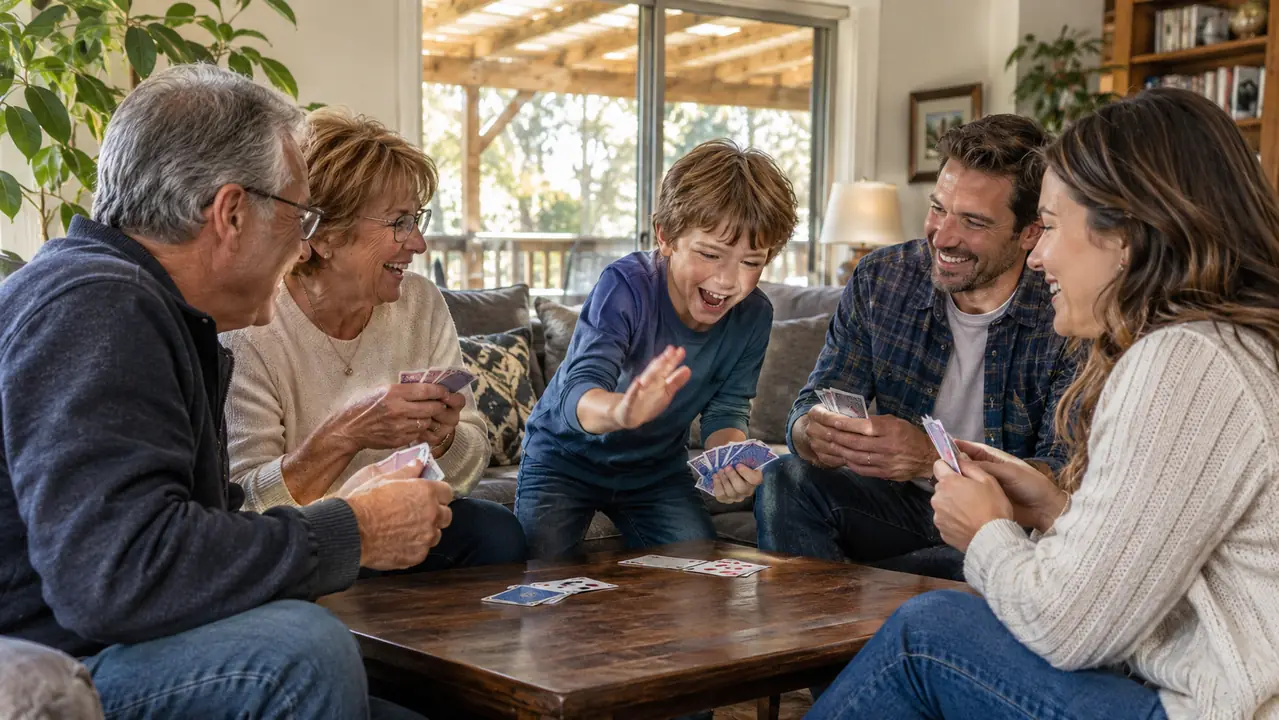
The player count is two to eight. Two is fine but quiet, and quiet is not why anyone buys this. Five or six is where it comes alive, because more eyes means the matching happens faster and the noise level climbs accordingly. Eight would be a birthday party, and I would move that outside to the porch and put the lemonade somewhere it cannot be knocked over.
The packaging is the newer eco-blister style, which means less plastic to wrestle with before a birthday. I noticed because I am the one who ends up with the scissors and the cut thumb. It opened in under a minute, which is not true of most toys that come through this house.
The Five Ways to Play, and What That Actually Buys You
The set is sold as five games in one, with the variations laid out in the rulebook. My family found two we liked inside the first week and has not gone back to the others. That is less a complaint about the game than a fact about families. You will find the version that suits your table and you will play that one until the cards wear out or the children grow.
The rulebook is short. I read it twice in one sitting, and the second read was only because I did not believe the first. That is a point in Asmodee's favor. I have opened rulebooks that ran twelve pages, closed them, and put the box on a shelf, and so has every parent I know. Short rules mean the game gets played the night you open it instead of the following Christmas.
What five variations actually buy you is a game that survives the age gap. The version that works for a table of adults is not the version that works with a five-year-old who needs a fighting chance, and having both in one small tin means you do not have to buy a second game in two years. I have a shelf of games we outgrew in a season. This one has stayed.
Where It Genuinely Falls Short
Adults lose. Not occasionally. Regularly. The matching does not care how old you are or how much you know, and Ray, who spent forty years fixing machinery, has been beaten by a seven-year-old often enough that he now announces he is not really trying. He is trying. I have watched his jaw.
It is loud. Five people saying different words at the same time is a headache after three rounds, and my ears are not what they were. We have a house rule about indoor voices that gets abandoned about ninety seconds into the first round, every time, without fail.
My eyes are sixty-seven years old, and picking out the matching symbol costs me a second of focus that a seven-year-old does not need. I wear my glasses to play this. I do not wear them to play checkers. That is not a defect in the game exactly, but if you are buying it to play with a grandparent who struggles with fine detail, know that the grandparent may be playing at a handicap.
Ten minutes a round means one round is never one round. The first time somebody wins, somebody else says again, and you are at the table for forty minutes. That is a good problem as problems go, but it is a problem if you intended to hand the tin over and go start supper.
We had one evening last fall that ended the game for the night. Four children, two adults, and a round that ran long because nobody would concede. By the end Mason was shouting the same wrong word over and over at the top of his lungs and Owen had woken from his nap on the couch. I put the tin on top of the refrigerator and handed out apples. It was not the game's fault exactly. It was too many people and too late in the day. But that is what a rainy Saturday looks like if you are not paying attention.
There is also nothing to it beyond the matching. No strategy, no planning, no slowly getting better in a way you can feel. A sharp-eyed child will win against an adult every time, and no amount of practice closes that gap. That is the trade Asmodee made: a game anybody can win on the first turn instead of a game that rewards whoever has played it longest. If you want a game where experience counts for something, this is not that game.
And the cards will bend. Not today, not next week, but children shuffle like they are kneading dough, and cardstock has a limit. Ours has held up well enough that I would buy it again, but I would not hand it to a seven-year-old and walk out of the room expecting it to come back flat.
What I Liked
- Runs about ten minutes a round, which is the real attention span of a young child
- The tin keeps 55 cards together and travels well
- Handles two to eight players without needing a second set
- Cardstock cards have survived a summer of drops and rough shuffling
- Teaches losing gracefully with low stakes and quick rematches
- No pieces to lose, no turns to wait for
Where It Falls Short
- The six and up label is about losing, not about matching, and the tin does not say so
- A two-year-old in the house means the cards go up on a shelf
- Adults lose to children constantly and it shows
- Rounds end fast enough that you will be asked for another and another
- Cards will eventually bend from child-style shuffling
- Almost no strategy, so older children may drift away by nine or ten
The matching is the easy part. The hard part is teaching a five-year-old that losing a ten-minute game will not kill him, and this game hands you about forty chances to practice.
Who This Is For
This is for a household with children roughly six to ten who need something to do at a table that does not involve a screen. It is for grandparents who want a game in the bag that works whether two children show up or six. It is for the parent who has learned that a twenty-minute board game is four minutes of fun and sixteen minutes of managing a meltdown. Ten minutes, done, everybody back outside.
It is also a decent gift for a child you do not know well, because it does not require reading, does not require a particular interest, and packs small. I keep one in the spare bedroom with the books and the crayons. It has been played by children I had never met before that afternoon.
Who Should Skip It
Skip it if there is a two-year-old in the house and no high shelf. Skip it if you want a quiet activity for a long car ride, because this is not quiet and the driver will not thank you. Skip it if you are looking for a game with depth that adults will choose on their own after the children are in bed. And skip it if you are the sort of adult who cannot stand losing to a child in front of other adults, because that is going to happen in the first five minutes and there is no graceful way out of it.
If you are on the fence, be honest about the ages at your table. At seven and up, this earns its space on the shelf and it will get used. At four or five, buy it and wait a year, or buy it and expect to be the one who manages the tears for a season. That is the whole of it.
If you have a seven-year-old and a short patience for long games, this earns its shelf space
Asmodee built a ten-minute game that a five-year-old can win and a grandparent can lose. The tin is the reason it is still in one piece at my house.
Amazon Check Today's Price on Amazon →