
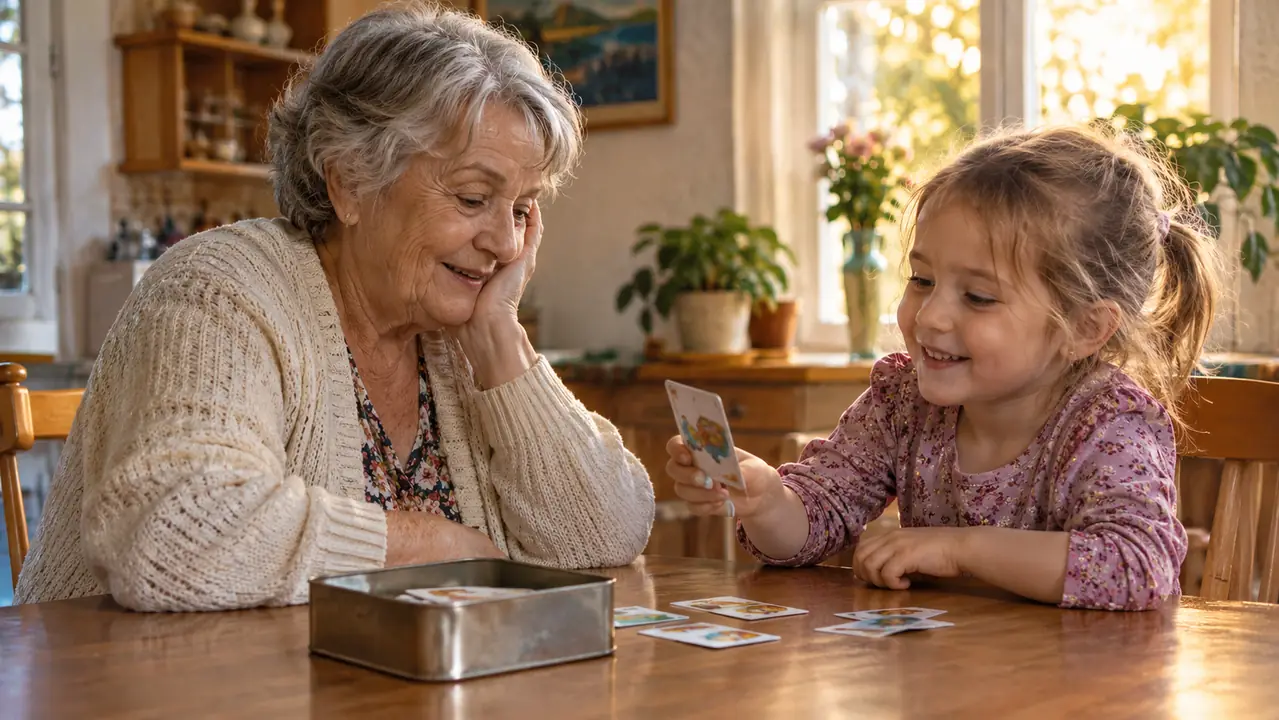
Ellie beat me four times in a row before I understood what was happening. She is seven. I am sixty-seven, I spent thirty-four years as a labor and delivery nurse, and I have built a good part of my personality around noticing small details. None of it helped. Spot It! Classic, from Asmodee, is the rare game where the youngest player at the table has a genuine advantage, and it took me about a week to decide I was fine with that instead of irritated by it.
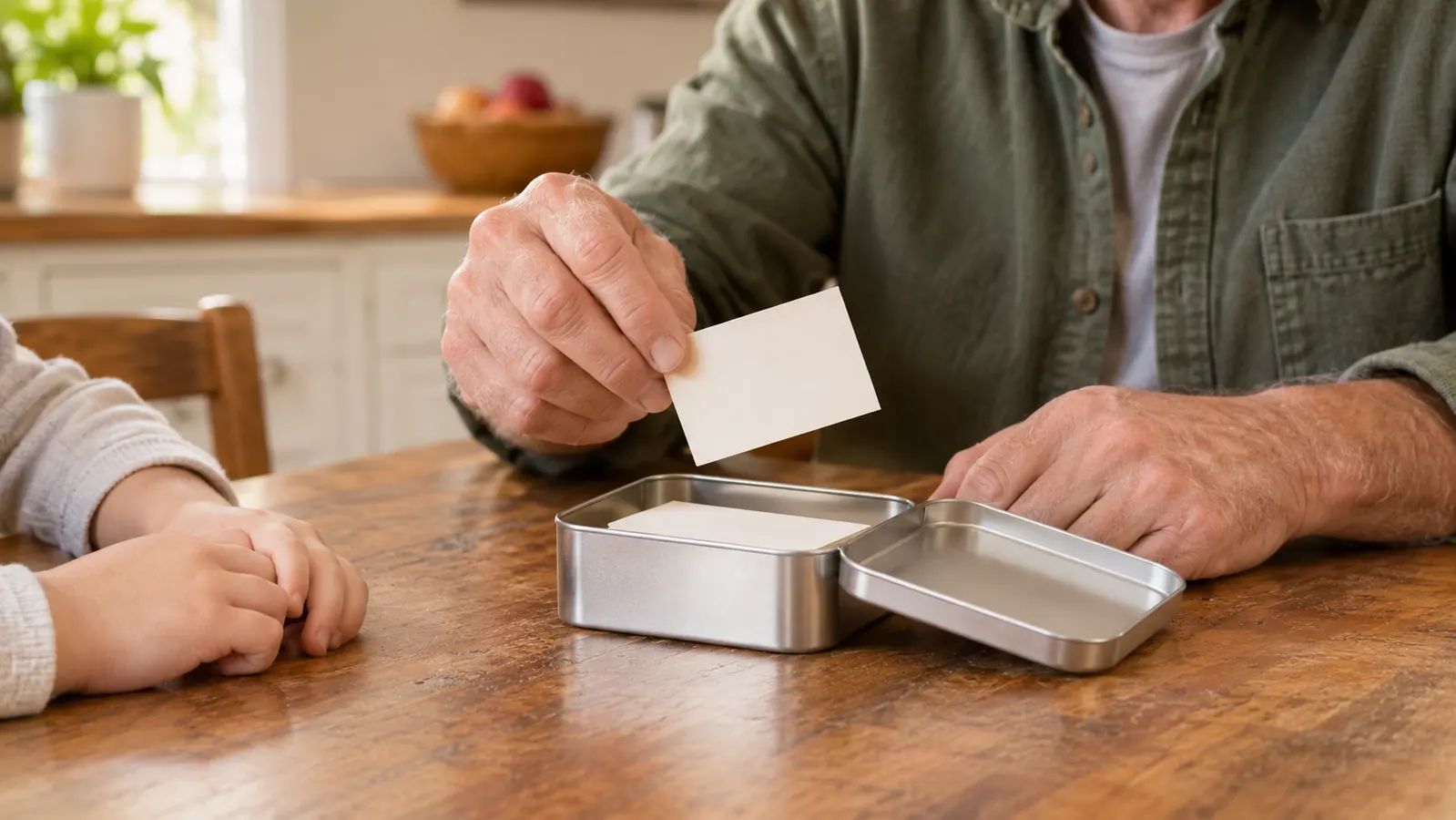
That was two summers ago. The tin lives in the spare bedroom now, on the shelf beside the picture books, and it comes out most weekends when the grandkids are here. Here is the short version of what it is. A small tin holds fifty-five cards. Each card carries a cluster of pictures, and between any two cards there is one picture that appears on both. You race to spot it first. The Asmodee set includes a rulebook and five different ways to play, and the tin says two to eight players, six years and up, ten minutes a round. Those numbers turned out to be honest, which is not always the case with a game box.
The Quick Verdict
A ten minute card game that lets a five-year-old genuinely compete with a grown adult. Nothing to lose, nothing to charge, and nobody has ever asked to stop playing.
Amazon Check Today's Price →One small tin, ten minutes, and nobody asking for a screen
Fifty-five cards, five ways to play, and a metal tin that survives being sat on in the car. It is the thing I reach for after supper when the plates are cleared and the children are drifting toward the television.
Amazon Check Today's Price on Amazon →How I've Used It
Most weekends the grandkids come out to the house. Most weekends there is a stretch after supper when the adults are cleaning up and the children are starting to circle the television like moths. That stretch is what the tin is for. We clear the plates, I set the tin in the middle of the table, and whoever is closest gets to open it. There is a small ceremony to it that I did not plan and would not give up now.
The first few times, I let Ellie and Mason play alone and I watched from the sink. That lasted maybe two rounds. The game is better with three or four people, because half of the fun is hearing somebody else shout a picture name a half second before you do. Ray plays when he is not out in the garage. He has the worst eyesight at the table and the most competitive streak, which is a bad combination for him and a fine one for the children.
I also take the tin with us. It fits in my handbag, which is not something I can say about most of what the grandkids own. It went to a doctor's waiting room in March and to a restaurant in Tyler where the food took forty minutes longer than anyone had planned. Both times it bought us a quiet half hour and cost me nothing but my dignity, since Mason won both.
What I did not expect is how much the game has become the thing the children ask for by name. Ellie is at the age where she has opinions about everything, and her opinion is that the tin comes out first and the picture books come second. That is a strong endorsement from a seven-year-old who has a bedroom full of crafts she could be doing instead.
The Age Gap Problem, and Why This One Solves It
The trouble with buying a game for a seven-year-old and a five-year-old is that they are not the same customer. Games Ellie can win by thinking, Mason loses because he cannot read the cards yet. Games Mason can win by being fast, Ellie wins by being faster. Somebody ends up crying, and it is almost always the smaller one. I have watched this happen with two other games in this house and I have put both of them on the top shelf where nobody asks for them.
Spot It! sidesteps the whole problem because the skill it rewards is not reading and it is not arithmetic. It is visual scanning, and a five-year-old is genuinely good at that. Mason finds matches on his sister's card before I find them on mine. His hands are smaller, so his cards sit closer to his face, and I have decided that is his edge and not mine. The tin says six and up. He was five when we started. He needed one rule explained twice, and then he needed nothing at all.
The other thing that helps is that a round is short. Ten minutes is the estimate on the tin, and most of our rounds run closer to five. When Mason loses, he loses fast, and we are on to the next round before the disappointment has time to settle in. When he wins, he gets to win in front of everybody, and then we play again. That rhythm matters more than any clever bit of game design, in my opinion. A long game gives a small child too much time to lose badly.
What Comes in the Tin, and How It Holds Up
Fifty-five cards and a rulebook in a metal tin, roughly 5.9 inches by 3.3 inches. The cards are cardstock, which is not fancy, but they have survived two years of a five-year-old shuffling them badly and one incident involving a juice cup. The tin is the part I would pay attention to if you are buying this as a gift. A cardboard box would be in pieces by now. This one gets tossed into a bag, sat on in the car, and stepped on once in the driveway, and the cards inside are still square.
The rulebook is short and printed plainly. I read it once for the main game and then again for the variations. Ellie read it herself last year, which tells you how complicated it is, which is to say not very. She then explained it to her grandmother, which was a nice piece of role reversal and I let her have it.
The one thing I would flag is that fifty-five cards is a lot of cards to pick up off a floor. There is no board, no timer, no little plastic pieces to lose behind the couch. Just cards. At my house that is a point in its favor, since we are still missing pieces from three other games and I have stopped pretending we will ever find them.
What I Noticed as a Nurse: The Two-Year-Old
Owen is two, and he puts everything in his mouth. That is not a knock on Owen, that is what two-year-olds do, and thirty-four years of nursing taught me to take it seriously rather than hope for the best. The cards are small enough to be a hazard for a child that age, and the manufacturer's age recommendation of six and up exists for a reason. It is not a suggestion to be worked around.
So the rule at our house is simple and it does not bend. The tin comes out when Owen is napping, or when his mother is holding him, or when he is out on the porch with Ray. If he is on the floor with us, the cards stay in the middle of the table and out of his reach, and if he starts grabbing, the game goes back in the tin. No negotiating with a toddler. I have tried that and I have never once won.
I would say the same to any grandparent reading this. This is not a toy to leave out on the rug. Played at a table with an adult nearby, it is a calm, quiet, safe game with no sharp edges and nothing that needs a battery. Left where a two-year-old can get to it, the cards are small parts, plain and simple. That is worth saying out loud because the cards do not look like a hazard. They look like cards.
Five Ways to Play, and the Two We Actually Use
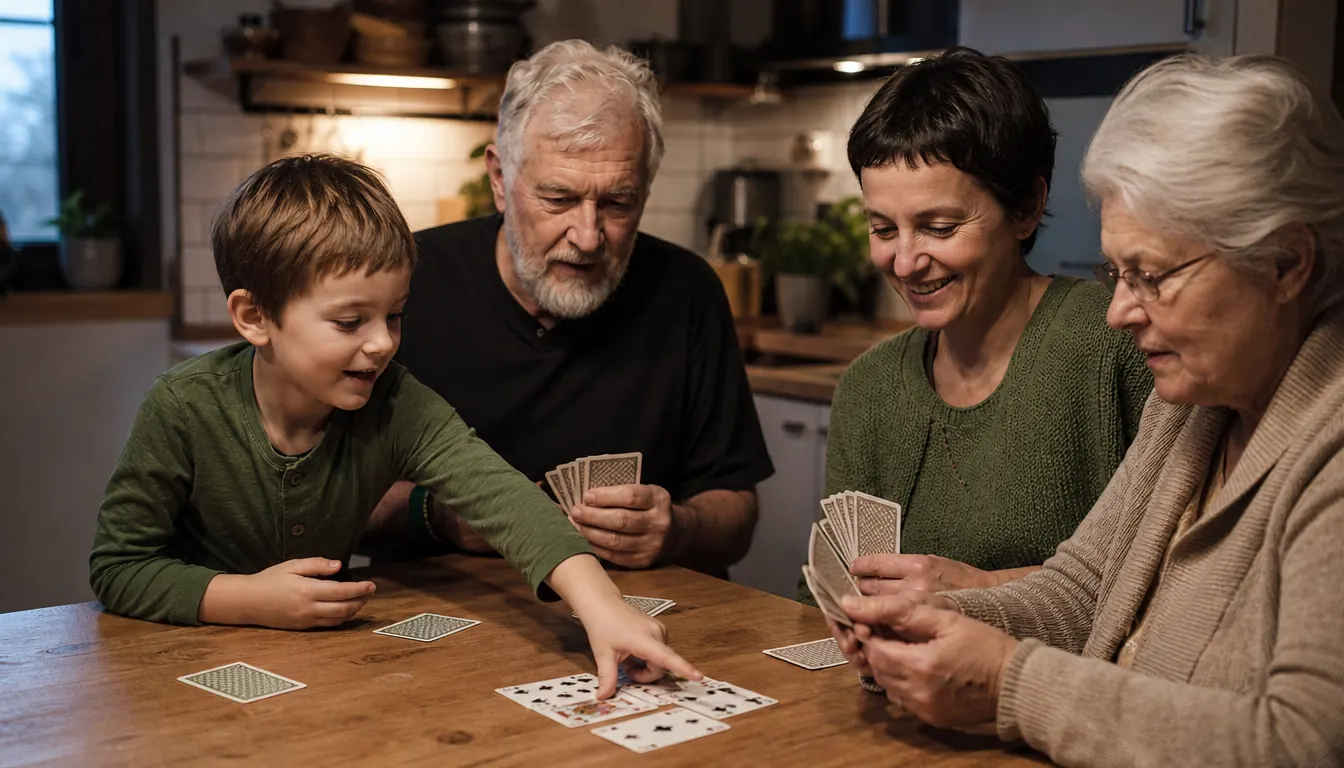
Asmodee puts five variations in the set, which sounds like marketing until you sit down and try them. They change who wins and how fast. One is a straight race to spot the match. Another has you trying to get rid of your cards before everyone else does. The variations are all built on the same matching idea, so once a child understands the basic rule, the rest take about thirty seconds to explain. That is the real value. You are not buying five games. You are buying one game with five different moods.
We use two of them regularly. The simple race is the default because Mason can play it without any help from me. The get-rid-of-your-cards version is what Ellie asks for when she wants to feel clever, and it is what Ray asks for when he wants to beat her, which he rarely does. The other three come out when there are more people at the table, which at our house means holidays and the week in summer when the grandkids stay over.
I have not met a variation yet that confused anybody past the first round. The estimate of ten minutes a round is accurate for a family group. With two sharp players it runs faster. With a table of six or eight it runs longer because there is more shouting, and the shouting is most of the point as far as I can tell.
What It Doesn't Do
Two honest complaints, because a review with no complaints in it is not a review. First, it does not get anybody moving. This is a sit-down game at a table, and there is no version of it that involves running around the yard. I walk most mornings and I try to keep the grandkids active rather than parked in front of a screen, and I am not going to pretend a card game counts toward that. What it counts toward is the hour after supper when everybody is tired and nobody needs to be wound up. That is a real thing to count toward, but it is not exercise and I will not dress it up as such.
Second, the pictures repeat, and a child who has played it fifty times starts to recognize the same symbols quickly. Ellie is at that point. She still plays, but she plays because her brother wants to and because she likes winning, not because the game surprises her anymore. Two years is a fair lifespan for a family game and that is about what we got. I expect Mason has another two years in it, and by then Owen will be old enough to take a turn, and the tin will start over with him.
What I Liked
- A five-year-old can genuinely beat a grown adult, which is rare and worth the money on its own
- Five minute rounds mean nobody gets bored and nobody has time to lose badly
- Fifty-five cards and a rulebook fit into a metal tin small enough for a handbag
- Five variations built in, so it stays playable as the children get older
- Nothing to lose. No board, no timer, no small plastic pieces
- Cardstock cards have survived two years of hard use and one juice cup
Where It Falls Short
- The cards are small parts and a two-year-old will get to them if you leave them out
- It is a sit-down game and does nothing for active time
- A seven-year-old starts recognizing the pictures after a couple of years
- Fifty-five cards on the floor is a genuine chore to pick up
Mason is five. He finds the match on his sister's card before I find it on mine. That is the whole game, and it is why he asks for it by name.
Who This Is For
Grandparents with grandchildren spread across a few years, roughly five to nine, who want something to do at the table that does not involve a screen. The mixed age group is the sweet spot. If you have one child who reads and one who does not, this is the game that keeps both of them at the table without anybody being handed a handicap. It is also a good gift for a household where the adults are tired and the children are not.
It is a good bag game too. The tin is small, there is no setup, and you can put it down mid-round and pick it back up. If you have a waiting room, a restaurant, or a long car ride in your future, this earns its place in the handbag. I would bring it before I brought a tablet, and I have done both.
Who Should Skip It
If there is a two-year-old in the house who roams freely, think about where the tin will live before you buy it. The age recommendation is six and up and it means it. You can absolutely play this with a younger child at a table under supervision, which is what we did, but you cannot leave it on the floor. If the honest answer is that it will end up on the floor, buy something with bigger pieces. Families looking for a toy that burns energy should skip it as well. This is a sitting game. There are plenty of good things to throw and climb on. This is not one of them.
And if the children in your life are already ten or eleven, the surprise has largely gone out of it. They will play a round to be polite and then reach for something with more to it. I would not spend the money there.
The tin I keep in the handbag, not on the shelf
Fifty-five cards, five ways to play, one metal tin. It has survived two years of weekends, one restaurant meal that ran long, and a five-year-old who beats me four times out of five.
Amazon Check Today's Price on Amazon →