
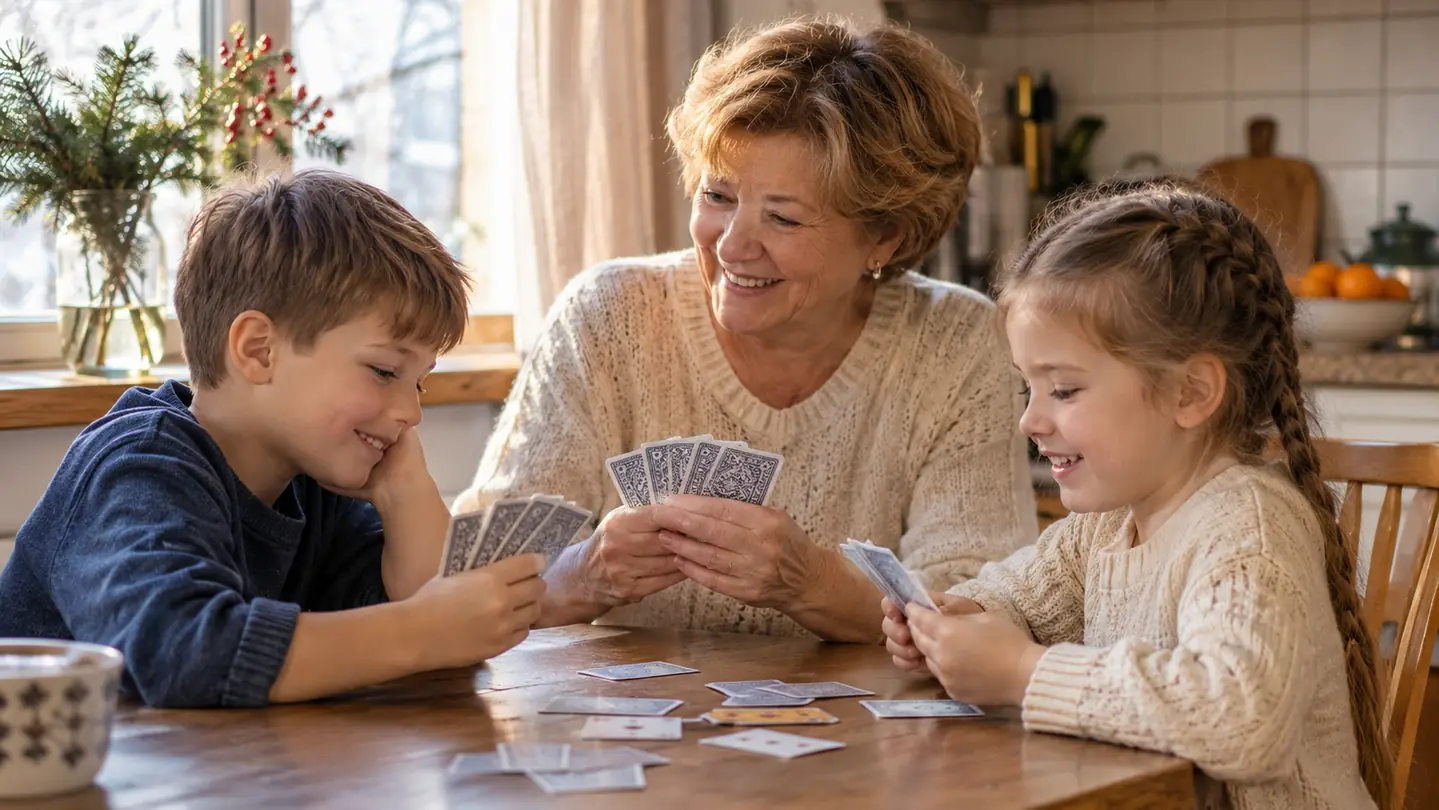
For three Sundays running I put both games on the kitchen table and let Ellie, Mason and Owen go at them while Ray timed the arguments. Spot It is the one that ended up in the drawer by the back door. Uno went back in the cabinet above the microwave, and that tells you most of what I think.
Here is the short answer. If your grandchildren are spread across a wide age gap and you want a game that is over before anybody's patience runs out, the Asmodee Spot It! Classic set is the better fit for your house. If your table is mostly seven and up and already knows the rules by heart, Uno earns its keep. I own both and I am not getting rid of either. But if you are buying one thing this weekend, the mixed-age table is what Spot It was built for, and the rest of this is why.
| Spot It! Classic (Asmodee) | Uno | |
|---|---|---|
| Age on the box | 6 years and up, per Asmodee's label | 7 and up on the classic deck |
| Players | 2 to 8 | 2 to 10, and more with a second deck |
| Reading required | None. Symbols only | Numbers and colours, plus the action card words |
| Waiting between turns | Nobody waits. Every player searches at the same moment | Strict turn order, which is where a five year old drifts |
| Round length | About 10 minutes | 15 to 20 minutes, sometimes longer |
| Explaining it to a new player | Two sentences, and a five year old is playing | Needs a few practice rounds if the player is new to it |
| Holds a table past age ten | A good filler, but the older kids move on | Still gets played by teens and adults |
| Number and colour practice | Pattern matching only | Numeral and colour recognition built into every card |
| Storage and travel | Comes in a tin measuring about 3.3 by 5.9 inches | Cardboard box that softens in a bag |
| Small parts around a toddler | 55 small cards that slide off the table | Small cards on an open table, same risk |
| Best for | Mixed ages where the youngest has to compete fairly | A settled group that already knows the rules |
Where Spot It Wins
The whole game fits in one sentence. Every card has symbols on it, every card shares exactly one symbol with every other card, and whoever spots the match first takes the card. I explained it to Mason, who is five, in about thirty seconds. He then beat me three times in a row before supper, and he knew he had done it fair, which is not something I can say about most games I play with him.
That matters more than it sounds when your grandchildren are seven, five and two. Ellie reads. Mason is still learning. Owen puts everything in his mouth. A game where nobody has to read puts all of them on the same footing as Ray and me, and it is the only thing in my house where a five year old can genuinely beat his grandmother and not feel like he was let win.
The set is plain, and I mean that as a compliment. Fifty five cards, one rulebook, one tin. Asmodee labels it six and up, two to eight players, about ten minutes a round. The tin measures roughly three and a third inches by six, so it fits in my handbag for a restaurant wait or a long afternoon in a doctor's office. There are five ways to play with the same cards, so when Ellie tires of one set of rules we turn to the next and it feels like a different game without anybody buying anything.
One more thing, and it is the reason the tin stays out. Nobody waits. Every player is looking at the same moment, so there is no gap for a five year old to fill with his elbows. Ray can hold Owen on his knee and still take part, because it only takes one hand and half an eye.
Where Uno Wins
I am not going to pretend Uno is the weaker game, because it is not. Uno is what my own children grew up on and it is what my grandchildren ask for by name. There is no teaching involved, because everybody at the table already knows it, including the neighbor kids who wander over. On a Friday night when I do not want to be a referee and a rulebook at the same time, that counts for a lot.
It also does something Spot It cannot. Uno has numbers and colours on every card, so Mason is practicing numeral recognition and matching without knowing he is practicing anything. He has to hold a hand of cards, wait his turn, and take a draw two without a meltdown. Turn taking is a real skill at five, and Uno works it every single round.
And Uno stretches further. My older grandchildren still play it. Adults play it without complaint. Add a second deck and a table of nine can stay at it for an hour at Thanksgiving. Spot It is a filler, ten minutes and done. Uno can be the whole evening, and there are afternoons when that is exactly what I want.
I will say the obvious thing too. Uno is not going anywhere. If I send a grandchild home with a game in a bag, it is the deck they already know. That familiarity is worth something, and I would be lying if I said otherwise.
Mason is five and cannot read a full Uno card without help. He beat me three times at Spot It before supper, and he knew he had done it fair.
How a Sunday Actually Goes
Last Sunday they arrived at eleven. Owen went straight for the toy bin, so the Spot It tin stayed on the kitchen table, out of his reach, because those cards are small. Ellie and Mason played three rounds before lunch. Each round runs about ten minutes, so it ends while they are still enjoying it rather than after somebody has lost interest and started sliding cards off the edge.
I tried it the other way first, and it went badly enough that I quit doing it. Week one I put Uno out when they walked in, thinking the familiar game would settle everybody. Mason lost two rounds in a row, slid off his chair, and was in the backyard before I had the cards gathered up. The game was not too hard for him. It was too slow. He was waiting on Ellie for most of it, and a five year old with nothing to do at a table will find something to do, and it usually involves his elbows.
After lunch we played Uno. That is when the waiting started. Ellie plays fast and Mason plays slowly, and the gap between their turns is where the trouble lives. I ended up sitting beside Mason and helping him sort his hand, which is what grandmothers are for, but I was playing the game for him as much as with him.
Ray is not a game person and he said it plainly. With Spot It he felt like he was playing. With Uno he felt like he was supervising. He could keep Owen on his knee through a whole round of one and not the other, and that is the difference in a single sentence.
There is a rhythm to it that I did not expect. Spot It gets played early, when everyone is fresh and loud. Uno comes out later, when the little one is down for a nap and the older two want something that lasts. Knowing which game belongs to which part of the day has saved me more arguments than any house rule I have ever made.
The tin that stays in the drawer by my back door
Fifty five cards, one rulebook, ten minutes a round, and a five year old who can win it honestly. That is what I hand people when their table looks like mine.
Amazon Check Today's Price on Amazon →The Question I Get From Other Grandmothers
The question I get most is whether Spot It is too simple to hold a seven year old. It is not, or not for long stretches. Ellie plays it hard, and she is at the age where she wants to beat adults rather than be allowed to win. The five variations in the rulebook matter here, because changing the rules resets her interest and buys me another fifteen minutes at the table.
I tested that on a rainy Saturday in March, when the yard was too wet for anybody to go outside and the whole afternoon had to be spent indoors. We worked through all five variations in one sitting, one after another, and I watched Ellie get quieter and more focused with each change of rules rather than less interested. By the fourth version she was playing against Ray and beating him, and she had forgotten entirely that she had been bored an hour earlier.
The other question is whether a four or five year old can keep up. Mason does, with one adjustment, which is that I show him my card as well as his so he has two chances to find the match. He is slower than Ellie and he knows it. What he is not is left out, and that is the part I care about more than who wins.
What Each Game Is Actually Teaching
Strip the fun off both games for a minute, the way a nurse looks at a toy. Spot It is visual scanning and quick matching. A child has to hold two images in his head, compare them, and throw out the wrong ones fast. That is the same skill as finding a word on a page or a number on a bus schedule, and it is practice he does not notice he is getting.
Uno is sequencing and self control. Colours match colours and numbers match numbers, and on top of that a child has to hold his hand, watch the pile, and not play the card he most wants to play. Waiting is harder than matching. If your grandchild needs work on patience, Uno is the better teacher. If he needs to feel quick and capable in front of his cousins, Spot It is.
Neither game needs a screen, a battery or a charger, which in my house is most of the point. They come out of a drawer, they get played, they go back. That sounds like nothing until you have watched a seven year old spend a whole Sunday on a tablet and then be miserable by four in the afternoon.
The Small Parts Question
Thirty four years in labor and delivery taught me to look at a toy the way a two year old would, which is to say with my mouth. Spot It is fifty five cardstock cards and a tin. There is nothing in the tin to choke on, but the cards are small, they slide off a table, and they end up under a chair where Owen will find them. Uno has the same problem. I would not leave either one on the floor with a toddler in the room.
Our rules are simple. Cards stay on the table, the tin goes back on the shelf, and we count the cards before they go away. Fifty five going in, fifty five coming out, and if the count is short we look under the chairs before anybody leaves. That count started because of a Tuesday in the summer when Owen came around the corner with a card in his fist and no game had been played that afternoon. If Owen is in the room we play at the kitchen table and not on the rug. Asmodee puts six and up on the tin and I hold to that for a child playing on his own, though Mason started at five with me sitting right beside him and a hand on the tin.
Who Should Buy Which
Buy Spot It if your table looks like mine. Grandchildren spread over several years, adults who would rather play than explain, and a visit that needs to move on to the backyard after ten minutes. The no reading rule, the simultaneous play and the tin are three small things that add up to a game a five year old and a seventy year old can play as equals.
Buy Uno if your group is older and settled, if the same four people play every time, and if you want something that can run an hour. Buy it if you want a five year old quietly practicing numbers and colours and learning to wait his turn. If I am honest, buy both, because they cover two different kinds of afternoon and neither one takes up shelf space. But if you are buying one, and your youngest is under six, start with Spot It.
Start with the one a five year old can win honestly
Two to eight players, ages six and up, about ten minutes a round, and a tin that survives being carried around in a bag. If your grandkids span a few ages, this is the one I would put in your hands first.
Amazon See Spot It! Classic on Amazon →