

I spent thirty-four years as a labor and delivery nurse, and I can still tell you the Apgar score of a baby I delivered in 1994. I could not tell you the first funny thing Ellie said. That is what got me started on this. She is seven now, Mason is five, and Owen is two, and the years between their birthdays move faster than any of mine ever did. I wanted a record of it that did not live in my phone and did not depend on my memory holding up.
I tried the other ways first. I bought a scrapbook and quit after three pages because the photographs were not good enough. I kept notes in my phone until I changed phones. I told myself I would simply tell the children things when they were older, which assumes I will remember and assumes they will ask, and neither one is promised. What finally worked was a plain bound book that sits on the side table where I can reach it. Mine is the Grandmother's Journal from Blue Streak, 96 pages, 9 by 11 inches, published by Weldon Owen. It has outlasted every other attempt because there is nothing to set up and nothing to organize.
The book that got me writing after three abandoned scrapbooks
Ninety-six pages, 9 by 11 inches, and no wrong way to fill it. If you have been meaning to start for years, start with the book in your hand instead of the plan in your head.
Amazon Check Today's Price on Amazon →Step 1: Choose the book before you plan the project
Nearly every grandmother journal I have seen abandoned was abandoned at the planning stage. The owner picked a theme, bought a set of pens, decided on a system for the pages, and then never wrote page one because page one had to be perfect. A journal is not a craft project. It is a place to put sentences. Keep the setup under five minutes and you will still be writing in it a year from now. Mine needed no setup at all beyond a pen, which is the whole reason the Blue Streak book is the one still in use at my house.
The size matters more than people expect. At 9 by 11 inches, a printed photograph or a folded church bulletin slips between the pages without being trimmed down first. At 96 pages, the book is thin enough that a person does not feel behind on it, which is the feeling that kills these things. I have filled a little over half of mine at one page in most weeks, and I am sixty-seven with a husband, a yard, and three grandchildren underfoot on weekends.
Buy one book, not three. This is where I went wrong the first time, buying a separate album for each child and then feeling guilty every time I opened one of them. One journal covers all of them. I write an entry to Ellie, then one to Mason, then one to Owen, and I put the date and the name at the top so nobody has to guess who a page was for. A grandmother with one book writes. A grandmother with three books alphabetizes and then stops.

Step 2: Fill the first pages with facts, not feelings
The temptation is to open to page one and write something beautiful. Do not. Write the census instead. Full names, birth dates, the town you were born in, your mother's maiden name, your husband's people and where they came from, the schools you attended, the work you did and for how long. Ray and I sat at the kitchen table one Sunday and filled four pages with nothing but dates and place names, and those four pages are the ones my son will need most. Ray and I did ours on a Sunday afternoon in October and quit after an hour, which was plenty. He remembered the year his people left Arkansas. I remembered the name of the church where we married and could not remember the month to save my life. Write down what you know, leave a blank line where you do not, and come back to it in a week. A blank you can fill later. A blank you never made is gone for good.
These are the questions that have no other answer once we are gone. It took me eleven years to find my own grandmother's maiden name, because nobody wrote it down and the people who knew it died in the wrong order. Four pages and an hour would have spared me that. You can spare your grandchildren the same hunt while you are still here to be asked.
Include the plain facts about your own life that your family thinks they already know. I worked thirty-four years in labor and delivery. My grandchildren know me as the person who keeps crackers in the pantry and does not like the dog on the couch. They do not know what a night shift was like, or why I chose that floor, or what I was afraid of in my first year. They will wonder, and by then the asking will be harder.
Step 3: Write in fifteen-minute sittings instead of big evenings
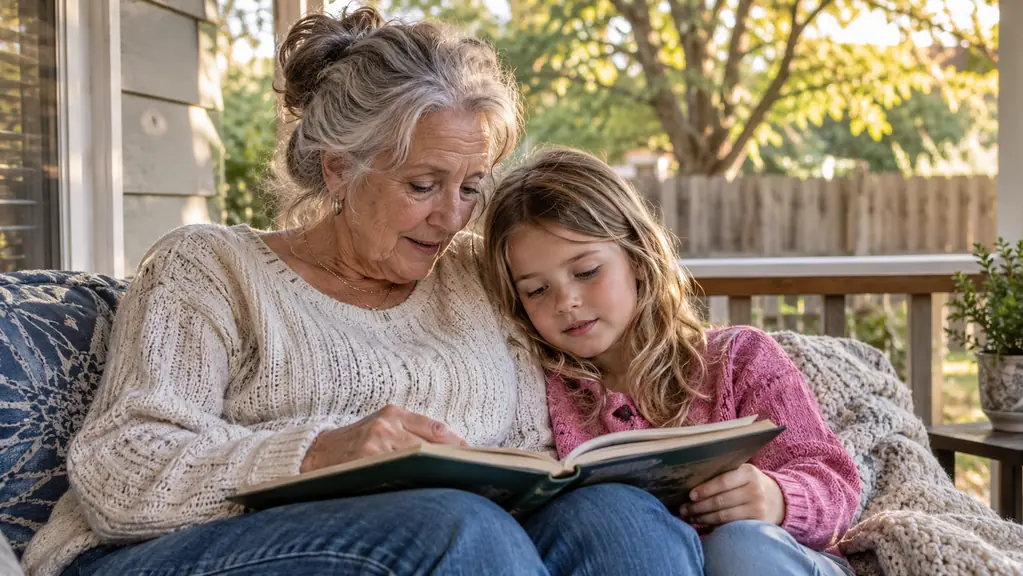
For a long time I saved the journal for an evening when the house would be quiet and I could do it properly. That evening came about twice a year. Now I write on the back porch on Sunday afternoon, one page, while the coffee is still hot. Fifteen minutes is the whole commitment. The book stays in the basket beside the porch chair, so there is no fetching it and no deciding whether today counts as a journal day.
One page is the goal. If a page feels like too much, one paragraph is the goal. Some Sundays I write three sentences and close the book, and those three sentences are the reason I kept the habit at all. The first Sunday I tried it, I wrote four lines about Owen falling asleep in his car seat in my driveway and it took nine minutes by the kitchen clock. Nine minutes. I had been putting that off for a year. Mason coming up the porch steps to show me a beetle is not an interruption of the work. It is the material. I wrote about the beetle.
Do not edit yourself. Cross things out, misspell the words, put the date in the wrong corner, start over on the next page instead of tearing the old one out. A messy page is worth ten blank pages that would have been lovely. My handwriting has gotten worse rather than better in two years, and no grandchild of mine has ever once complained about it.
Step 4: Answer the questions they will actually ask
Children do not ask what you learned in life. They ask specific and odd and wonderful things. What were you like when you were five. What did your house smell like. Did you ever get hurt. What did your mother say when you were in trouble. What did you do for fun before there was anything to watch. Write those answers down while you can still answer them, because they arrive suddenly and usually in the car.
The ordinary Tuesday is the thing that disappears first. Nobody writes about a Tuesday. So write about one. My grandmother's kitchen smelled like coffee and ironing, and I have never seen that written anywhere. Your grandchildren will want the smell of your kitchen more than they want your advice, and they will want it in about thirty years, when there is nobody left to ask. Ellie asked me in the truck last spring what I did for fun when I was her age, and I gave her a flat answer because I could not think of one on the spot. I have an answer now, three pages of it, and it will be there the next time she asks.
Tell the truth where it is age appropriate, and tell it plainly. I wrote about the year I was sick and frightened, in a way a seven-year-old can hold now and a twenty-year-old will understand better later. I left out nothing that mattered and I did not dress any of it up. Grandchildren can tell when they are being handled, and a journal that only contains the flattering parts reads like a card, not a person.
Step 5: Keep the journal visible and tell them it exists
A journal in a drawer is a journal that stops. Mine lives in a basket beside the porch chair in plain sight, and Ray knows where it is, which has mattered more than I expected it to. Tell the parents as well. Their memory of what you were like is not the same as yours, and they will remind you of things that are worth a page and that you had already forgotten.
Tell the children it exists. Ellie saw me writing in mine and asked what the book was. I told her it was a book about her, and she asked whether she could see the page. She can, when she is older and when the pages about her are further along. For now she knows the book is there and that it is about her, and that has changed how she talks to me at the table.
Decide now who keeps it. Write a line inside the front cover saying what the book is and whose it is, because a book with no name in it gets lost in a move or divided up by well-meaning people. It is a small thing to do and it is the difference between a keepsake and a box of loose paper somebody sets on a shelf and forgets. Mine has my full name, the town, and the words for Ellie, Mason, and Owen written inside that cover in my own hand, and it took a minute. Ray knows which basket to bring if I am ever back in the hospital.
What Else Helps
A pen you actually like is worth more than a good intention. Mine is a plain ballpoint from the drugstore, and I keep two in the basket because one is always going dry. Keep an envelope tucked in the book for photographs, a lock of hair, a program from a school play, the receipt from a first haircut. Date everything. An undated entry is a riddle for the person reading it thirty years later, and they will not be able to ask you what you meant.
Keep a small notebook in your purse for the lines you hear and cannot stop to write down. Owen said something in the grocery store last month that I got onto the back of a receipt, and I copied it into the journal that night while it was still exact. If writing feels stiff, say the entry out loud first. I talk to myself in the kitchen anyway, and the sentences come out better spoken than they do on the first try.
Any good bound book will do the job, but the one you can hold comfortably is the one you will actually use. The Blue Streak journal has held up through two years of Sundays, one summer with a two-year-old on my lap, and a coffee spill that I am not going to describe. Nothing has come loose and nothing has fallen out, which is more than I can say for the scrapbooks.
The entries my grandchildren will read are not the big ones. They are the ones where I wrote down what the kitchen smelled like on a Tuesday in March.
One page this Sunday is enough to start
Ninety-six pages, 9 by 11 inches, and a place for all the things you keep meaning to say out loud. Ellie already knows her book exists. Your grandchildren can know too.
Amazon Check Today's Price on Amazon →