

Ellie asked me last month what my grandmother's kitchen smelled like. I had my hands in the dishwater and I could not answer her. I could see the woman's face clear as day. I could not smell the kitchen. That is how two keepsake books ended up side by side on my kitchen table, the Grandmother's Journal from Blue Streak and the question-a-page book called Tell Me Your Life Story, Grandma.
They are both good at something, and they are not good at the same thing. The Blue Streak book is a 96-page, 9-by-11-inch keepsake journal you fill yourself, and it leaves room for photographs and the small paper things you want to hand down. Tell Me Your Life Story, Grandma is a guided journal that asks a question and gives you the page to answer it. One is a scrapbook with a spine. The other is an interview in book form.
If you want to hand a grandchild a finished object she can keep on a shelf, the Grandmother's Journal is the one. If you have ever sat down to write your life story and frozen at the empty page, the question book is the one. I have used both, and I would not talk you out of either.
I am sixty-seven and I have three grandchildren, so I am at the age where people start handing you books like these and asking you to fill them in. I have also cleaned out two houses after a death, and I can tell you what families keep. They keep handwriting. They keep recipes in the margin. They keep the thing that was actually touched. That is the lens I used here.
How I Compared Them
I did not test these books the way I tested a car seat. There is no crash rating for a journal. What I did was buy both, write in each for two weeks, and hand each one to Ray and ask which he would have kept if his own mother had filled it out. He picked the heavy one. He always picks the heavy one.
I also checked the things a nurse checks. Does the page take a pen without the words showing through on the back. Does it lie flat enough to write in without cracking the spine. Does it survive a coffee cup and a two-year-old. The answers were yes, yes, and not the two-year-old. Nothing survives the two-year-old.
For the paper I used a plain ballpoint on the first page of each book and held the sheet up to the window, which is how we checked chart paper on the ward. No bleed through on either one. The Blue Streak page had more room around the writing, though, and that matters when your hand starts to wander near the bottom of a page and you still have two sentences left to say.
| Grandmother's Journal | Tell Me Your Life Story, Grandma | |
|---|---|---|
| What it is | A 96-page, 9-by-11-inch keepsake journal you fill yourself | A guided journal built around one printed question at a time |
| Getting started | You sit with a page and decide what belongs there | The first question is already there, so you start writing |
| Room for a photograph | The wide page leaves space for a photo beside your writing | The page goes to the answer, so a photo needs its own album |
| Heft | About two and a third pounds, the size of a coffee table book | A workbook you finish and put away |
| For a reluctant writer | A blank page can stop a person cold | Answering is easier than inventing |
| One child or all of them | Built as one keepsake for one grandchild | Easy to pass around or copy for a whole family |
| Best for | The grandmother who wants to make an object | The grandmother who wants to be asked |

Where Grandmother's Journal Wins
The first thing you notice is the weight. The Blue Streak journal runs about two and a third pounds and stands nine by eleven inches, so it is not a workbook you tuck in a purse. It is a book that takes up space on purpose. At 96 pages, each page gets to be generous, and a photograph taped to one side does not make the whole thing buckle. I put it on the kitchen scale to check the listing, because I weigh everything, and it came in at two pounds five ounces. Ray carried it out to the porch for me once and asked whether I was taking it to the doctor.
It keeps the keepsake part in view. The title says memories and keepsakes, and the format backs that up. I have taped in a church bulletin from my mother's funeral, a recipe card in Ray's handwriting, and a photograph of the house on Maple Street before they tore it down. A question book would have asked me a question. This one let me put in the evidence.
The illustrated edition also gives you something to look at besides your own handwriting. That sounds like a small thing until you are writing about a funeral and the page feels too plain to hold it. Weldon Owen published this edition in 2017, and it looks like a book that was made to be kept, not a workbook that was made to be finished and tossed in a drawer.
Where Tell Me Your Life Story, Grandma Wins
Here is the honest part. The question book is easier to start. I sat down with both of them on a Tuesday morning, coffee poured, no plan, and I wrote three pages in the question book before I wrote a single word in the Blue Streak journal. A printed question is a small push. What was your first job is easier to answer than tell me your life story.
It is also easier to hand around. If all three of my grandchildren want a piece of the same story, a question book can travel from one house to another, or be answered in a few sittings over a summer. The Grandmother's Journal is built for one child, one book, one shelf. That is a strength in one column and a limit in the other.
And it is easier on the woman who does not think of herself as a writer. Plenty of good grandmothers froze in school when a teacher said write five hundred words. A question is a smaller door. You answer it, you look up, and you have written a page anyway.
The book that lets you tape in the recipe card
Ninety-six pages, nine by eleven inches, illustrated, and heavy enough to hold a photograph without bowing. This is the one I would buy for a grandchild who will keep it.
Amazon Check Today's Price on Amazon →What You Actually Get With the Grandmother's Journal
Ninety-six pages. Nine by eleven inches. A little over two pounds. An illustrated edition from Weldon Owen, published in 2017, printed in English. That is the whole physical fact of it, and it is enough. There is no app, no battery door, and nothing to charge, which at my age I have started to rank higher than I used to.
The size is the part I would think about before you buy. Nine by eleven does not fit in a drawer with the bills. It wants a shelf, or the top of a cedar chest, or the desk in the spare bedroom where the grandkids sleep. That is where mine lives, because that is where they will look for it.
I measured that shelf with a tape measure first, the same way I measure a crib rail before I trust it. Eleven inches tall and a little over half an inch of depth, which left room for the framed photograph of my parents on one side and nothing on the other. Measure before you order. This is a book that needs a home waiting for it, not a book you squeeze in somewhere and forget.
It is a book for one child. The title says for my grandchild, singular, and that is not an accident of wording. If you have three grandchildren and you buy one copy, you will spend the rest of your life explaining why Ellie got a book and Mason did not. I bought one per child. That is the real cost of the format, and it is worth saying out loud.
The spine is a little over half an inch thick, so it stands on a shelf without sagging, and the pages do not fan out the way a cheap paperback does. Small thing. It is the small things that make a keepsake feel like a keepsake.
One more thing about the pages. Ninety-six of them sounds like a lot until you start writing about your own mother, and then it sounds about right. I have used thirty-one so far. I am not rationing them. I write on one side and tape the photograph on the other, and the book still closes flat.
I wrote three pages in the question book before I wrote a word in the Blue Streak journal, and that told me more than any product description online.
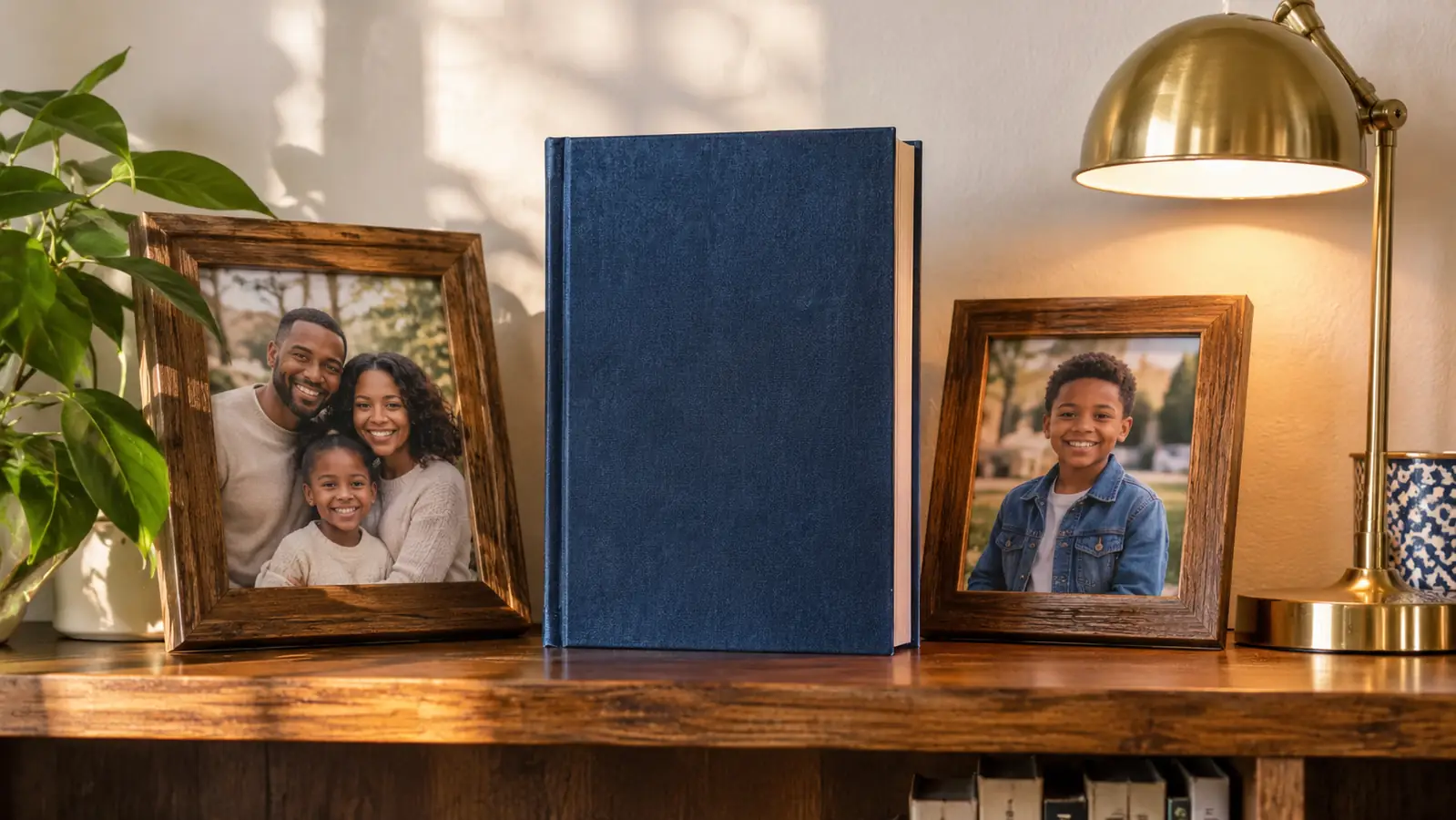
The Kitchen Table Test
I gave both books a fair run. Two Tuesday mornings, same chair, same coffee, Ray puttering in the garage. The question book got me writing faster. The Grandmother's Journal got me writing longer. One is a warm-up and one is the main event, and most of us need the warm-up first.
The second Tuesday I started in the Blue Streak book first, on purpose, to see whether the order changed anything. It did not. I still filled a page of the question book before I found a story I wanted to tell at length, and the story I told at length took four pages once I got going. That is not discipline on my part. It is simply what each page asks of you when you sit down in front of it.
There is also the matter of who the book is for when it is done. The question book is a record. It answers the questions somebody else thought to ask. The Grandmother's Journal is a gift you are making with your hands, and it shows. My granddaughter will know what my handwriting looks like when I am tired, and she will know what I sounded like when I was trying to get a story right.
Ray is not a sentimental man. He read two pages over my shoulder and said the question book sounded like a job interview. Then he picked up the Blue Streak journal and said this one sounded like me. He is not wrong. The questions ask you to report. The big book asks you to sit down and stay a while.
One practical note from a nurse. Neither of these is a toy. Owen is two and had the corner of the question book in his mouth before I got my coffee poured. If you keep a pen with the book, keep the pen up high. The books go on the shelf above the reach of a two-year-old, same as the scissors.
What Neither Book Does
Neither one will write itself. That sounds like a joke and it is not. The most common complaint I hear about keepsake journals is that they sit empty on a shelf for four years. The book is not the gift. The book is the invitation. If you are buying this for your mother, the real gift is the hour you sit with her while she fills it in.
Neither one is a family history project, either. Do not buy a book like this expecting it to cover four generations. It covers you, and only the parts you get around to. That is enough if you start. It is not enough if you wait for the perfect Tuesday.
Who Should Buy Which
Buy the Grandmother's Journal if you want to make something. If you have photographs in a shoebox and recipes in three different hands and a story you want told in your own words, this is the book for it. It is also the better gift to give, because it looks like something, and a grandmother on the receiving end will know you spent more than a minute on her.
Buy Tell Me Your Life Story, Grandma if you want to be asked. If you are the kind of woman who can talk for an hour but freezes when somebody hands her a blank page, this is the kinder book. It is also the better choice for a grandmother who wants to give the same answers to all her grandchildren, rather than one book per child.
And if you are buying for your own mother or grandmother, ask her which one she would use. Not which one she likes the sound of. Which one she would actually sit down with on a Saturday. I have watched more than one keepsake journal sit empty because it was the right gift and the wrong book.
One book, one grandchild, one shelf
If you want the keepsake that looks like something the family will fight over in fifty years, this is it. Ninety-six illustrated pages, nine by eleven inches, and room for the photograph and the recipe card both.
Amazon Check Today's Price on Amazon →