
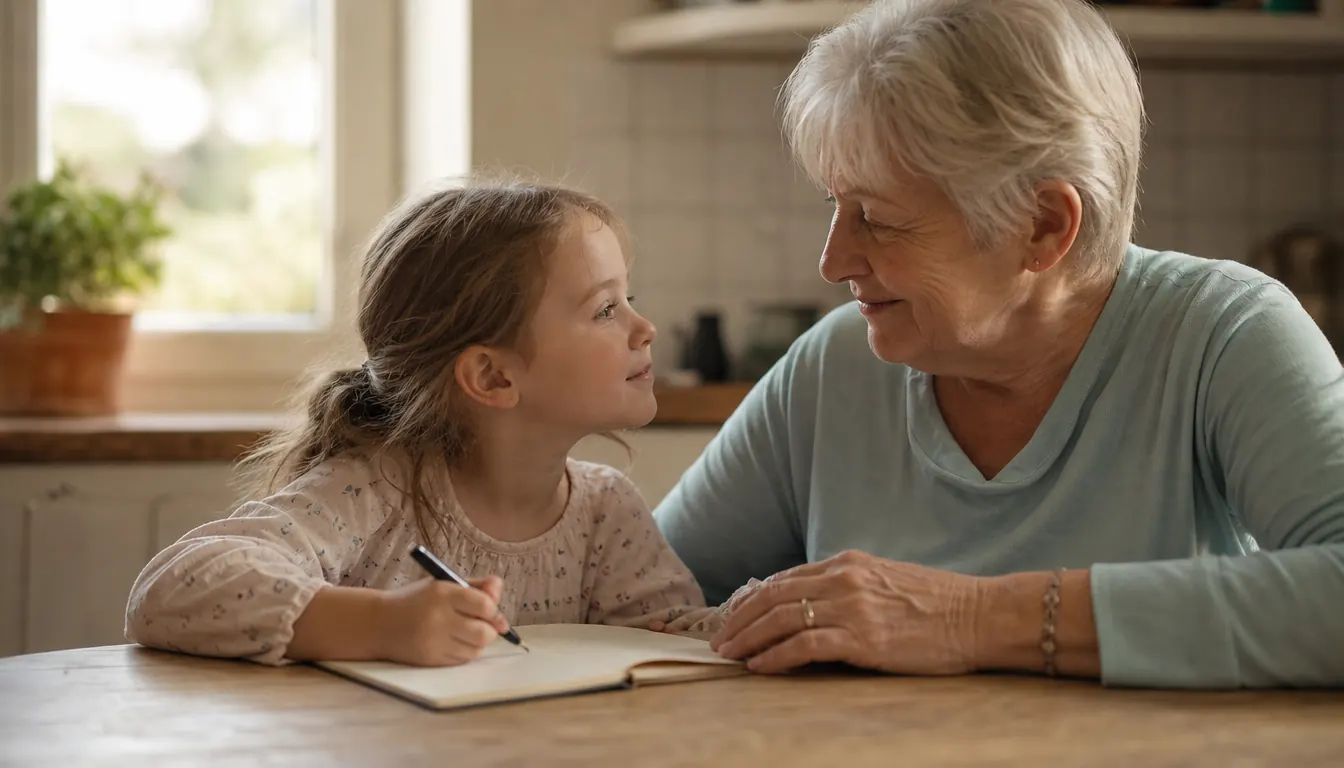
I did not set out to become the family record keeper. It happened the way most things happen at my house: slowly, then all at once. I am 67, a retired labor and delivery nurse, and Ray and I have three grandchildren who come through our back door most weekends. Ellie is 7 and wants to build something every visit. Mason is 5 and would live outside if we let him. Owen is 2 and still puts everything in his mouth. Last spring I bought Grandmother's Journal: Memories and Keepsakes for My Grandchild from Blue Streak. I thought I would fill it out in a weekend. Several months later, I am still writing in it, and that has turned out to be the point.
The book is 96 pages, 9 by 11 inches, and 2.31 pounds. It was published by Weldon Owen in April 2017. Those numbers matter more than they sound. A keepsake journal is not a greeting card. It has to survive being carried from the kitchen table to the porch, and it has to feel substantial enough that a grandchild will keep it after I am gone. This one does. But I want to be plain about what it asks of you: time, handwriting, and a willingness to sit with memories that are not all tidy.
The Quick Verdict
A substantial 96-page keepsake journal that rewards slow, steady use. It is not a one-weekend fill-in, and it asks for handwriting and honesty, but it gives a grandmother a real place to leave the small stories that would otherwise disappear.
Amazon Check Today's Price →The journal that gets better after a few months on the counter
If you want a keepsake you can build slowly, this is the one I kept writing in. See the current listing and check the details for yourself.
Amazon Check Today's Price on Amazon →How I've Used It
I started with Ellie because she is the oldest and because she asked the most questions. She wanted to know what I was writing, so I showed her. That was a mistake only in the sense that she now considers the journal hers to inspect. I wrote about the first time I held her, the way her hair smelled, the sound of her laugh when Ray pushed her on the swing. I wrote about the summer she learned to pump her legs on her own and shouted across the yard for me to watch. Some entries are a page. Some are three lines. The book does not care. It holds what you give it.
With Mason, I wrote faster and messier. He is 5 and rarely still, so my entries are shorter and more like field notes. The first fish he caught. The way he fell asleep in the truck after a birthday party. The sentence he said about the moon. I found that writing about him in small pieces worked better than trying to make each entry a speech. With Owen, I have written less because he is 2 and because his life is still mostly naps and snacks and the business of learning to use a spoon. That is fine. I have months left to fill in the rest.
I keep the journal on the kitchen counter, near the salt and pepper, because that is where I actually sit down. If I put it on a shelf, I would forget it. The 9 by 11 inch size is large enough to write comfortably but not so large that it takes over the table. I have used a plain ballpoint pen. I also keep a few printed photographs from the drugstore between the last pages. They fit beside the writing without making the book bulge.
I have also used the journal to write down things I would not have thought to tell them. The summer Ray taught Ellie to whistle. The way Mason lined up his trucks on the porch and called it a parking lot. The fact that Owen is the only one of the three who will eat tomatoes straight from the vine. These are not milestones. They are the texture of a childhood. A baby book would not have a place for them. This journal does.

What the Size and Page Count Mean in Real Life
At 2.31 pounds, the journal has a presence. You know you are holding something. That is a good thing for a keepsake and a less good thing if you plan to carry it in a tote bag every day. I have not carried it farther than the back porch. The 96 pages give you room to write more than a name and a date. If you are the kind of grandmother who wants to record a recipe, a story about your own childhood, or the way the light comes through the kitchen window in October, there is space for that. If you are the kind who wants a quick fill-in-the-blank book, this will feel like homework.
The publication date is April 2017, and the edition is illustrated. I mention that because it means the book has been around long enough to settle. It is not a trend item that will look dated in a year. The dimensions also make it a shelf book rather than a drawer book. It will sit beside a photo album without looking out of place. That matters if you want the grandchild to keep it, not just to receive it. A book that looks like a book gets kept. A book that looks like a novelty gets put in a box.
Filling It Out Over Several Months
Here is what nobody tells you about a journal like this. The first ten pages are easy. You are full of stories, and the pen moves fast. The middle is harder. You start to wonder if you are repeating yourself, or if the memories you have are the right ones. I stalled for about three weeks in July. Then I changed my approach. I stopped trying to write in order and started writing whatever came to me when I was sitting at the table. The day Mason found a toad. The afternoon Ellie cut her own hair. The way Owen says Ray's name. The book does not require a timeline. It requires attention.
I also learned to write in short sittings. Fifteen minutes after breakfast. Ten minutes while the oven preheated. A few lines before bed. Over several months, those small sessions added up to far more than one long weekend would have. The journal became a habit instead of a project. That is the real test of a keepsake book. If it stays on the shelf, it stays empty. If it stays on the counter, it gets filled.
There were weeks when I wrote nothing. I want to say that plainly because I think other grandmothers will recognize it. Life gets in the way. The grandkids had a stomach bug that went through the house, and the garden took all my attention in June. The journal waited. When I came back, it did not make me feel guilty. It just opened to the next page. That sounds small, but it is the difference between a book you finish and a book you abandon.
The journal did not make me a better grandmother. It made me a more deliberate one. I wrote down the toad, the haircut, and the way Owen says Ray's name, and now those things will not disappear.
What It Does Well, and Where It Asks More of You
The best thing about Grandmother's Journal is that it slows you down. A grandchild will not remember that you bought a book. They will remember that you sat at the table and wrote about them. The 96 pages are enough to make that feel like a real record without becoming an encyclopedia. The size gives you room to include the small details that make a memory stick: the weather, the food, the thing that was said in the car. I found that the book invited me to write those details down because there was space for them.
The Blue Streak edition also feels sturdy in the hand. At 2.31 pounds, it is not a flimsy pamphlet. I have had it on the counter for months, and it has held up to being moved from the kitchen to the porch and back. The illustrated edition gives it a finished look. It does not feel like a blank notebook that someone slapped a cover on. That matters if you are giving it as a gift. The 9 by 11 inch size means it will not disappear into a stack of papers.
There is also a practical benefit to the size. The 9 by 11 inch pages give you room to write a paragraph without cramping your hand. If you have ever tried to write a memory in a small lined book, you know the difference. The page gives you space to finish a thought. That sounds like a small thing until you are trying to describe the first time you held a grandchild and you have only two inches of paper.
Where it asks more of you is in the writing. This is not a book you can hand to a grandchild and say, here, do this. It is a book that needs a grandmother's hand. If you are not comfortable writing by hand, or if you have arthritis that makes long entries painful, you will need to adapt. I have a touch of arthritis in my right thumb, and I found that shorter entries worked better than trying to fill a page. The book does not mind. But you have to be honest about your own limits. A journal filled with three honest lines is worth more than a journal filled with one forced page.

How It Compares to a Plain Notebook
I have kept a plain notebook for years. It is cheaper and it does not ask anything of me. But it also does not have the same weight. A plain notebook is for lists and phone numbers and the grocery store. This journal is for the grandchild. That difference changes what I write. When I open the Blue Streak journal, I am not writing to myself. I am writing to Ellie, Mason, and Owen. I am trying to leave them something they can hold.
That does not mean it is better than every alternative. If you want a baby book with a single clear order, this is not that. If you want something you can fill out in one afternoon, this is not that either. If you want a place to keep loose photos and school papers, a scrapbook will serve you better. The journal is for words. It is for the stories that would otherwise be lost. That is a narrower job, but it is the job I needed.
I also looked at a few other grandmother journals before I settled on this one. Some were smaller and easier to carry. Some had more decoration on every page. What I liked about this one was the plainness. It did not push me toward a certain kind of grandmother. It just gave me pages and let me decide what to put on them. That is worth something. A journal that tells you exactly how to feel can be harder to fill than one that leaves room for your own voice.
What I Liked
- The 96 pages give you room for real stories, not just names and dates.
- The 9 by 11 inch size is comfortable to write in and easy to keep on a shelf.
- At 2.31 pounds, it feels like a keepsake rather than a disposable notebook.
- The Blue Streak edition has a settled, illustrated look that will not date quickly.
Where It Falls Short
- It is a writing project, not a quick fill-in. Expect months, not an afternoon.
- The size and weight make it a shelf book, not something you carry around.
- It asks for handwriting and memory, which can be hard if you have arthritis or a busy house.
- It does not replace a scrapbook for loose photos and school papers.
Who This Is For
This is for the grandmother who wants to leave a written record and is willing to do the work. It is for the one who has stories that keep surfacing at the table and nowhere to put them. It is for the grandmother who understands that a grandchild will care more about the sentence you wrote in your own hand than about a perfect photo. If you are that person, the Blue Streak journal will give you a place to start. You do not have to be a writer. You just have to be willing to sit down.
Who Should Skip It
Skip it if you want a gift that requires nothing from you. Skip it if you know you will not write in it, because an empty journal is a sad thing to hand to a child. Skip it if you need a baby book with a fixed order or a scrapbook with pockets for every school picture. And skip it if the size and weight will keep it on a shelf. This is a book for the kitchen counter. If it will not live there, it will not get filled.
If you are ready to start with one honest page, start here
You do not have to fill it in a weekend. Put it on the counter, write three lines when you can, and let it become the record only you can leave.
Amazon Check Today's Price on Amazon →