
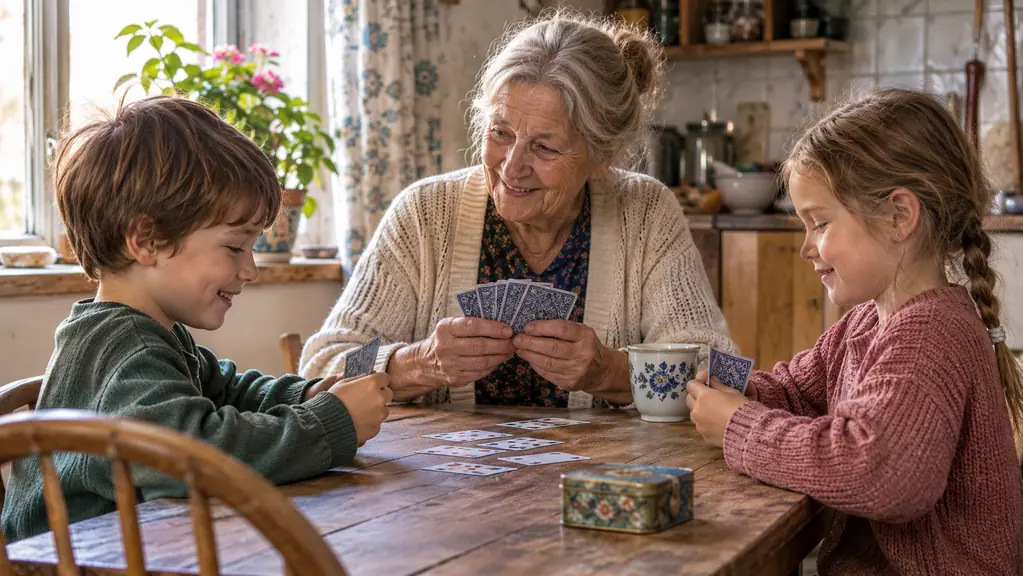
Three grandkids and one card game is a math problem I solve most Saturday afternoons. Ellie is seven and reads every word on the box, including the fine print. Mason is five and lasts about four minutes in a chair before his legs take over. Owen is two and still believes cardboard is a food group. Put all three at my kitchen table with a single game and something has to give.
The game that finally worked is Spot It! Classic from Asmodee. Fifty-five cards and a rulebook in a tin, ten minutes of playing time, two to eight players. The whole idea is that players race to spot the only matching symbol between two cards, which puts a child who cannot read and a child who cannot sit still on the same footing as a grown adult. The box says six years and up. Two of my three are under that line and we still play most weekends. It just took some adjusting.
What follows is the order we do it in now. None of it is complicated, and all of it came from watching a five-year-old quit a game he was losing. If you have a wide spread of ages at your table, this is where I would start.
Fifty-five cards, ten minutes, and nobody has to lose
Spot It! Classic takes two to eight players, runs about ten minutes a round, and comes with a rulebook covering five ways to play, so the same tin works for a rainy Saturday and a quick game before supper. It lives in my cupboard between the deck of cards and the dominos.
Amazon Check Today's Price on Amazon →Step 1: Teach the matching rule with two cards, not fifty-five
The first mistake I made was dealing a hand to each child and explaining the game to all three at once. Owen put a card in his mouth, Mason began flipping his like a skipping stone, and Ellie had quietly won twice before I finished the sentence. Now I teach the rule with two cards and nothing else on the table. No tin, no score, no audience.
The first time I tried this, back in June, I made the error of starting with the whole tin. I poured all fifty-five cards onto the table because I figured more cards meant more chances to find a match. What it actually meant was a table covered in overlapping cardstock, a two-year-old reaching across it, and a five-year-old who could not find a single pair because every card was half hidden under another one. We lasted about ninety seconds before I swept them back in. Two cards flat on a bare table is the version that works.
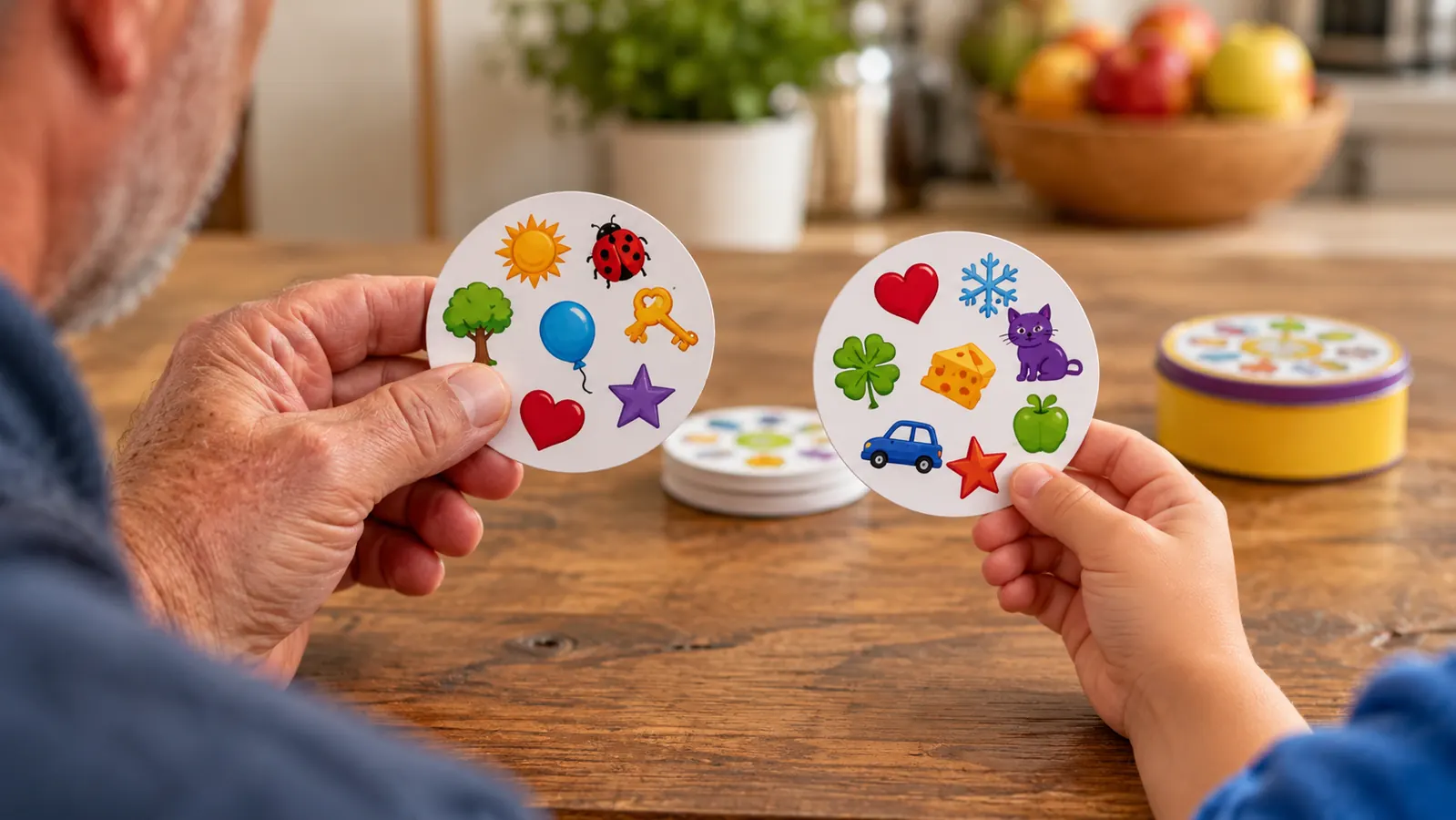
I lay two cards down, put my finger on a symbol I can see on both, and say, find the picture that is on both cards. That is the entire lesson. Then I take the cards back, shuffle, lay them down again, and let the child find one on their own. I do not help unless they ask. Most children find it in under a minute, and the look on their face when they do is worth the whole exercise.
Only after a child has found three matches in a row on a quiet table do we bring in the racing. Patience here pays for itself. A child who understands the rule but loses every round will keep playing. A child who does not understand the rule and loses every round will quit, and you will have a hard time getting them back to the table. I learned that the slow way, with Mason, on a Saturday in February.
Step 2: Put a big kid and a little kid on the same team
For a long stretch we played Ellie against Mason against me, and it was miserable. Ellie is fast. She spots the match and calls it before Mason has finished looking at the first picture. Being beaten by your sister every single round is not a game, it is a lesson in futility, and Mason figured that out quickly.
Mason quit on us in March. He had lost four rounds straight to Ellie, and he pushed his chair back, said he was done, and went out to the porch to sit with Ray. I let him go. There was no talking him back that afternoon and I knew better than to try. Watching from the kitchen window, though, I could see he was not really upset about losing. He was upset that he never once got to be the one who found it first. Teams fixed that in a way that no amount of encouragement was going to.
Now we play teams. Ellie and Owen against Mason and me, or Ellie and Mason against me, depending on who needs a partner. Teams change the arithmetic. Mason is not losing to Ellie, he is losing or winning with her, and he will stay at the table twice as long. It also gives Ellie a job she actually likes, which is being the one who explains the rule to her brother.
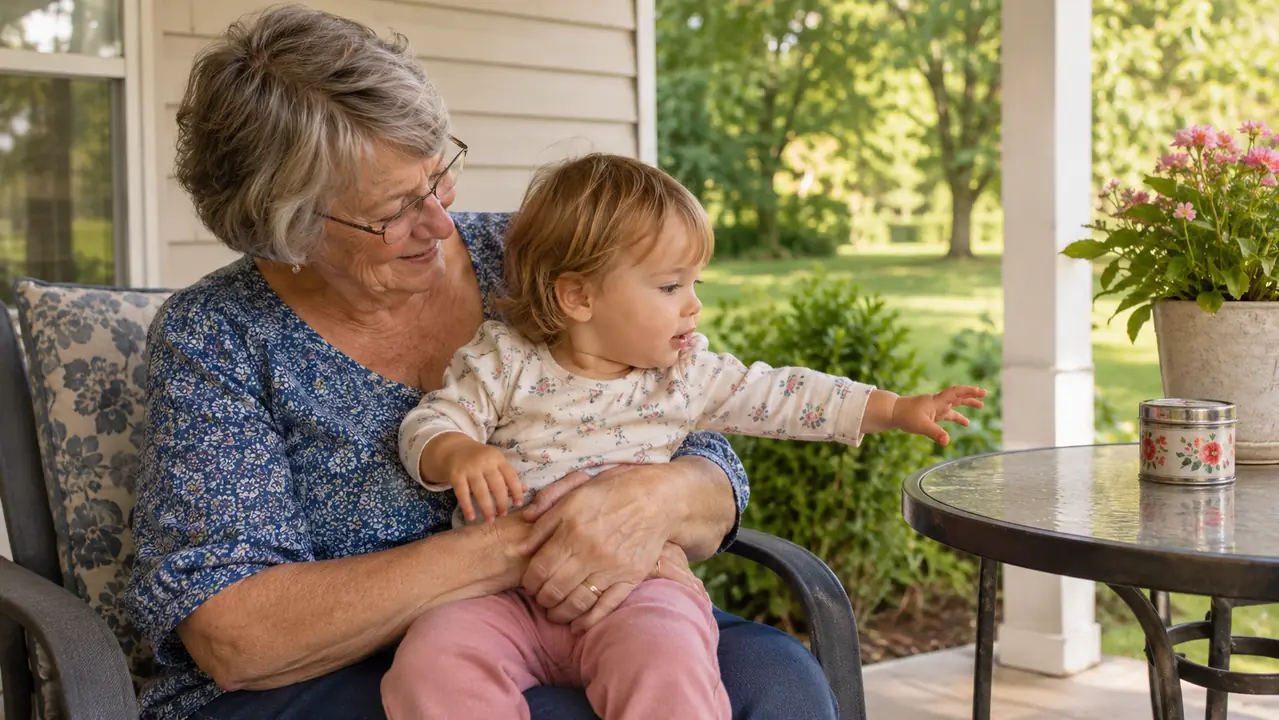
Owen's participation is mostly pointing. He sits on my lap or in the chair beside me, and when a card is laid in front of him he will put a finger on a picture. That is a real contribution to a team and he knows it. He does not hold the cards himself yet, and I will get to why in Step 5.
Step 3: Give the older ones a handicap, not a lecture
Telling a seven-year-old to slow down and let her brother win does not work. She can hear the pity in your voice, she knows exactly what you are doing, and she will either ignore you or lose on purpose so obviously that Mason notices. Either way the game is ruined.
So we have house rules instead. Ellie has to count to two before she can call a match. She can see it as fast as she likes, she just has to wait. Mason can point at his match, and Ellie has to say hers out loud, which costs her an extra half second. When Mason gets quicker, we tighten Ellie's rules and loosen his. Nobody has been told they are being handled. The rounds are simply closer than they used to be.
We wrote the rules on an index card and taped it inside the tin lid, which sounds fussier than it is. Ellie's line reads count to two. Mason's reads point and say. Mine reads no reaching across the table, mostly for my own benefit. Having it written down matters more than you would think. A seven-year-old will hold you to a card, and a rule that comes out of an adult's mouth mid-round sounds like a punishment, while a rule that was already on the card is just the way the game is played. We revise the card every other month or so, usually after Mason has gotten faster and Ellie has noticed.
The box says six years and up. Two of my three grandkids are under that line, and the tin still comes out most Saturdays.
Step 4: Play three short rounds, not one long game
The listed playing time is ten minutes, and in our house a single round runs closer to three. We play best of three. That is short enough that Mason's attention holds to the end and long enough that the winner feels like they earned it.
Between rounds we stop and put the cards down. That sounds trivial and it is not. Thirty seconds of nothing, everyone sitting back, a drink of water, is enough to reset a five-year-old who is about to tip over the edge. If I deal the next round while the last one is still being argued over, the argument simply carries into it. The pause costs us half a minute and saves us the afternoon.
The other rule I hold to is stopping while it is still fun. There is a point in every afternoon, usually right after the second round, where one child is winning and another is getting tired. That is the moment to put the tin away. If you play one more round to be fair, you will spend the next twenty minutes managing a meltdown instead of enjoying your grandchildren.
I would rather hear can we play again than are we done yet. Ending early is how you get the first one. It also means the game stays in the rotation. A game that ends in tears gets quietly retired, and I have retired a few in my time.
Step 5: Protect the cards and the two-year-old
The cards are cardstock and they will take a bend. A two-year-old can fold one in half before you finish saying his name. The tin helps, and I keep the cards in it between rounds rather than loose on the table where a small hand can reach them.
The age label on the box says six years and up, and with a two-year-old in the house I pay attention to that. Owen's part in the game is supervised and it is pointing, not cards in his hands and not cards near his mouth. He is at the stage where everything goes in, and I have spent too many years as a nurse to pretend otherwise. When he loses interest, he gets down and plays with something else, and the game carries on without him.
I also look the pieces over the way I used to look over a room before a shift started. The cardstock is not a choking hazard, which was the first thing I checked, and it is the reason the game works with Owen at the table at all. The tin is the part I watch. The lid edge is thin, and a two-year-old will pry at a lid for a surprising length of time before anyone notices. That tin lives up on the shelf, not on the floor, and it comes down when I bring it down.
I count the cards back into the tin when we finish. All fifty-five, plus the rulebook. I do not know that a missing card ruins the game, but I do know I would rather not find out by discovering it in a diaper bag on a Sunday evening. The table gets wiped before anything else happens, and then everyone goes outside.
What Else Helps
Timing matters more than anything I have written above. We play before supper, not after. A hungry five-year-old is a different creature from a fed one, and a tired seven-year-old is worse. If the afternoon has already gone sideways, the game will not save it, no matter how short the rounds are. I aim for the stretch right after lunch, when the day still has some shape to it and nobody has started asking what is for dinner.
The other thing that helps is having a second activity ready for when the cards lose their shine. At our house that is usually something that gets them moving, because I would rather they were outside than sitting. Twenty minutes of cards on the porch, then everyone out to the yard and the tin back on the shelf. Ellie will often carry the tin to the spare bedroom afterward and play a quiet round with me while Mason digs, and that works too. Asmodee built a game that survives being handed to a seven-year-old without an adult hovering over every card, which is not nothing.
Spot It! Classic from Asmodee has earned its place in the cupboard, but it is not the whole afternoon and it does not need to be. Two to eight players, ten minutes at a stretch, and a rulebook with five ways to play built in means I can pull it out for a quick round with Ellie alone or all three of them together, and it holds up either way.
The tin that ends the what-do-we-play argument
One tin, fifty-five cards, ten minutes a round, and enough rules to keep three grandchildren of different ages at the same table. This is the one I keep on the shelf for weekends.
Amazon Check Today's Price on Amazon →