

I bought this book in March, wrote my name on the first line, and then left it on the dining table for eleven days. Not because I did not want to fill it out. Because I did not want to do it badly. That part does not make it onto a listing page. A book like this is not really a gift. It is an assignment with a bow on it, and the person who receives it is the one who has to decide whether the pages are good enough to hand down.
Grandmother's Journal: Memories and Keepsakes for My Grandchild is exactly what the title says. The Blue Streak edition runs ninety-six pages, nine inches by eleven, a little over two pounds, published by Weldon Owen in 2017. What it is not is a thing you hand over and forget. I am sixty-seven, I spent thirty-four years as a labor and delivery nurse, and I have filled out more charting than most people will see in a lifetime. This is the first book where the blank pages made me nervous.
The Quick Verdict
Worth owning and worth the months it takes to fill in. The paper, the size and the finished object all hold up. The only thing that fails is the version of us that buys it and never opens it.
Amazon Check Today's Price →Ninety-six pages, one grandchild, and a Sunday afternoon
The book does not fill itself in, and that is the whole point. If you are going to start, start this week with a pen in your hand rather than next year with a good intention.
Amazon See the Journal on Amazon →What You Are Actually Holding
The physical facts are short. Ninety-six pages, nine by eleven inches, two and a third pounds, in English, illustrated edition, published in April 2017. Those numbers matter more than they sound. Nine by eleven is bigger than a paperback and heavier than you expect the first time you pick it up one-handed. It does not go in a purse and it does not tuck into a glove box. It lives on a desk or a side table, which is fine as long as you have a desk or a side table you actually sit at.
The purpose of the book is not the paper. The purpose is that somebody has to write on it. A seven-year-old can hold it and turn the pages, but she cannot read what you have not written yet. That sounds obvious when it is written down. It stopped being obvious the first time Ellie pulled it off the table and asked me why so many pages were empty.
The size is the thing I would flag first if someone asked me in a store aisle. Nine by eleven is a book that needs a surface. I tried writing in mine on my lap in the porch chair once and gave up after three lines. If the person you are buying for writes at a kitchen table, this is the right shape. If she writes in bed with a book light, it is not, and no amount of good intentions will change that.
I want to be plain about what this is. It is a keepsake book that a grandparent fills in and passes down. I do not treat mine as a photo album. I keep a manila envelope of photographs beside it and slip them in where they belong. That is my workaround, not the book's doing, and I would tell anyone the same thing before they buy it.
The pages are meant to be written on by hand, which means the book is only as good as the hours you put into it. I have watched people buy a thing like this the way they buy a gym membership in January. The object is not the change. The object is a place to put the change.
How I Have Used It
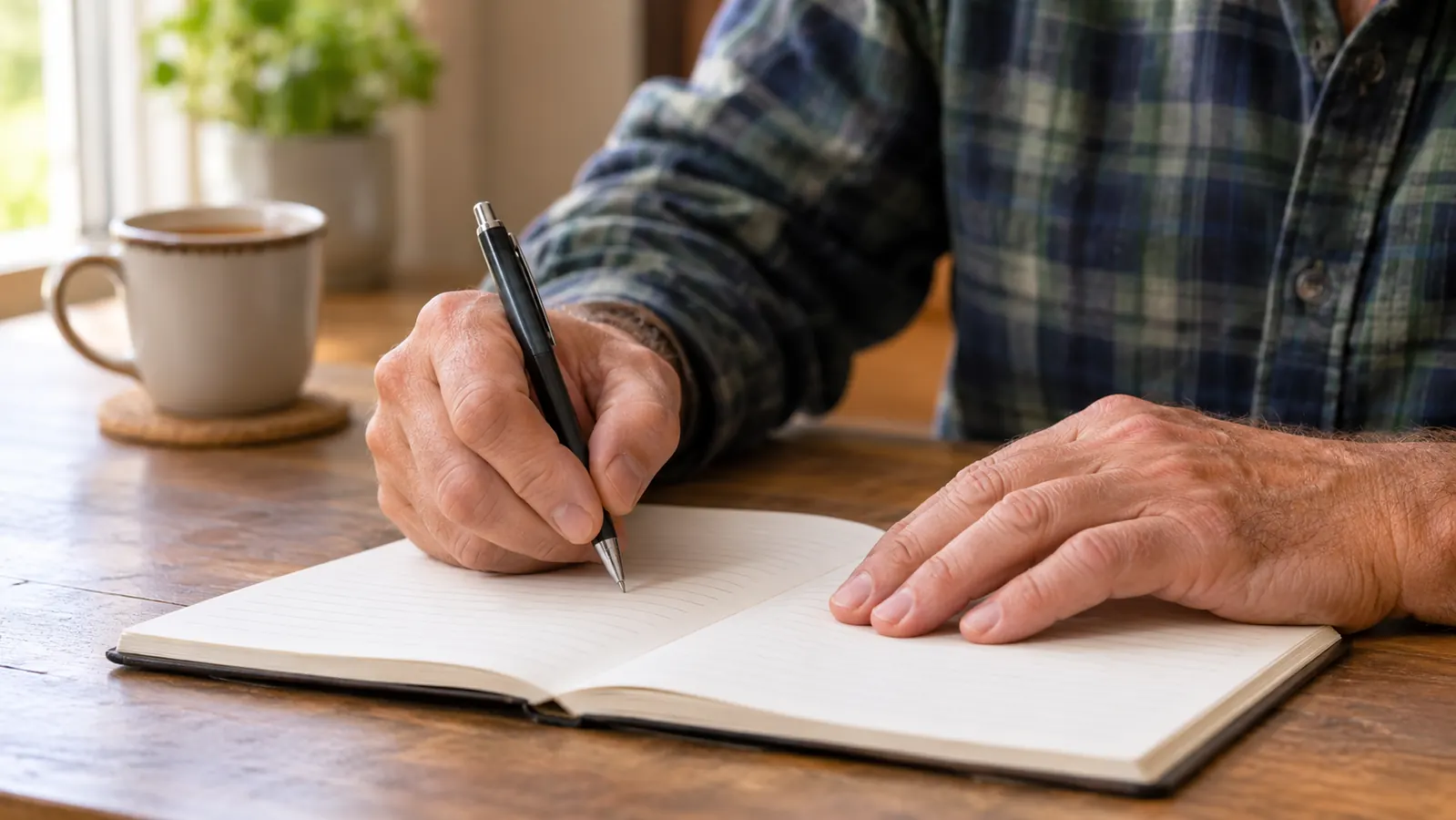
Sundays, mostly. The grandkids come most weekends, forty minutes of driving each way for their parents, and by two in the afternoon Owen is down for a nap and Mason is out in the yard with Ray. That is my window. I make a cup of tea, I sit at the dining table, and I write two pages. Not five and not ten. Two pages is about twenty-five minutes if I am thinking hard about what to say, and it is the most I can do before my handwriting goes soft at the ends of the lines.
I have kept that up since March. Some weeks I skip. The week all three of them were here in the summer, I did not open it once. But the habit held, and the habit is the entire thing. A book like this does not fail because the pages are wrong. It fails because nobody sits down.
I write in pen. Black ink, because pencil smudges when a seven-year-old reads with her fingers on the paper, and because I do not want the option of erasing myself later. That is the sort of decision you make about four pages in and then keep for the rest of the book.
The part I did not see coming is that Ellie has started treating it like a library book. She pulls it down and asks me to read the pages about her mother at seven years old. I have written about my own childhood, about how Ray and I met, about my mother's kitchen, and about the thirty-four years I spent on a labor and delivery floor. Ellie is seven, so she wants the pages about a seven-year-old. That is the return on the whole exercise, and it is worth more than the table the book sits on.
What I Liked
- Ninety-six pages means a subject gets a real answer, not two squeezed sentences.
- Nine by eleven gives a page enough room for an older hand to write comfortably.
- It is a finished object, not a printout, and it can be handed on again someday.
- The keepsake framing gives you permission to write down the small things, not just the dates.
Where It Falls Short
- One book, one grandchild. The original goes to one child and the rest get copies.
- Ninety-six pages is a long promise. It will sit half finished for months without a schedule.
- Blank pages carry guilt, and a book in a drawer helps nobody.
- It holds your handwriting and nothing else. No voice, no face, no recording.
What Nobody Tells You About Filling It Out
The first thing is that the writing is harder than the buying. I know two women my age who own this book. One finished hers. The other kept it in a drawer for four years and finally handed it to her daughter to fill in the parts she could not face. Neither of them did it wrong. But if you are giving this to someone in her seventies, understand that you are asking her for a summer of work, not an afternoon.
The second thing is handwriting. I have a mild tremor in my right hand that started around sixty-four. On a good day my letters are what they always were. On a bad day the ends of words go shaky and I have to decide whether to cross a line out or let it stand. I let it stand. My grandmother's handwriting went shaky too, and the shakiness is now the part of her letters I would not trade for anything.
The third thing is that some pages will ask for an answer you do not have a tidy version of. My father left when I was nine. There is no way to write that into a keepsake book so that it comes out charming. I wrote it in one plain sentence and turned the page. If you are the sort of person who will stall on a hard page and lose the whole book to it, plan for that. Write the hard one first, or write it last, but do not let it be the reason the book stays shut.
The fourth thing is arithmetic. I have three grandchildren and one book. Ellie is the oldest and she is the one who has attached herself to it, so the original goes to her. Mason and Owen will get copies, and I have said so out loud, at the table, so it is not a surprise thirty years from now. If you have four grandchildren and one book, decide the rule before you wrap it.
Ellie is seven, and the pages she asks for are the ones about her mother at seven. Ninety-six pages buys you that.
Where It Beat My Expectations
The Blue Streak edition is ninety-six pages, and that sounds thin until you sit with it. Two pages a Sunday is a year of Sundays, and most of us do not need a year. What surprised me is how much room there is for the short stories, the ones I would have lost otherwise. What Ray's mother called him when he was small. What my mother kept in the drawer beside the stove. Nothing that would go in an obituary, and everything a grandchild would want.
The illustrations are not the reason to buy it and they are not a reason to skip it either. They sit quietly and let the writing do the work. That is what I want from a book I am eventually handing to a grandchild.
It also works as a deadline, which I did not expect. I am not a person who journals. I have started four diaries in my life and finished none of them. This one I have kept up with because there is a named reader on the other end. Writing to nobody is hard. Writing to Ellie is easy.
And it has changed the weekends a little. Mason is five and cannot read most of it, but he knows the book exists and he knows it is about him. Last month he asked me whether I had written about the fish he caught off the dock. I had not. I wrote it that afternoon, in about six lines.

The Gift Question
People ask me whether this makes a good gift, and the honest answer is that it depends on the giver as much as the receiver. If you are handing it to a grandmother who already tells stories at the table, you are giving her a place to put them and she will use it. If you are handing it to someone who has never kept a diary and does not like writing by hand, you are giving her a chore with a ribbon on it.
The version that works best is a book plus a standing appointment. My daughter gave me mine with a note that said she would take the kids on the first Sunday of every month so I could write. That note did more than the book did. If you are going to give this, give it with an hour attached.
If you are buying for a grandmother who lives far away, this is one of the few gifts that gets better with distance. Every page she fills in is a page the child can read the next time they are together, and there is nothing to assemble, nothing to charge, and nothing that breaks.
One caution about all of that. Do not give it at Christmas with the whole family watching and expect her to start that night. The first page is the hardest one, and it is easier to write when nobody is waiting to see it.
What I Would Do Differently
I would have bought it earlier. My mother died at eighty-one, and there are questions I would have asked her at forty that I cannot ask now. The years when you think you have plenty of time are the years you should be writing things down.
I would also have made a list of the twenty things I wanted a grandchild to know about me before I opened the book. Instead I opened it first and spent the first month circling the same three pages, writing a sentence, crossing it out, and shutting the book. A list on the back of an envelope would have saved me four weeks.
The third thing I would change is the pen. I started with a fine tip because it looked neater, then switched after two weeks to something with a broader line that my hand could keep up with. Small thing. It kept me writing.
Who This Is For
It suits a grandparent who is willing to sit down and write, and who has at least one grandchild old enough to read it within the next few years. It suits people who already tell stories out loud and just need somewhere to put them. It suits a family that is spread out, where the visits are twice a year and the ordinary details do not travel. And it suits the grandparent who is not especially sentimental but is organized, because most of this is an organizing job with feelings attached.
Who Should Skip It
Skip it if the person you are buying for will feel watched by a blank book. Skip it if there is an estrangement in the family that the pages will run straight into, unless you are ready for the writing to be honest about it. Skip it if the grandchild is two and the grandparent is eighty-five and the years are not there. And skip it if what you want is a photo album, because this is not that, and it will disappoint you on the first Christmas morning.
One last thing, and I mean it kindly. Do not hand someone this book expecting that she will finish it. A friend of mine has one that is a third full and she has decided a third is enough. A third full is still her handwriting, still her stories, still going to her granddaughter. The Blue Streak edition is a sturdy enough object to survive being half finished, which is more than I can say for the guilt.
The best time to start was ten years ago. The second best is this Sunday.
Ninety-six pages, one pen, and a named reader at the end of it. That is the whole offer, and it is a better one than most gifts manage.
Amazon See the Journal on Amazon →