
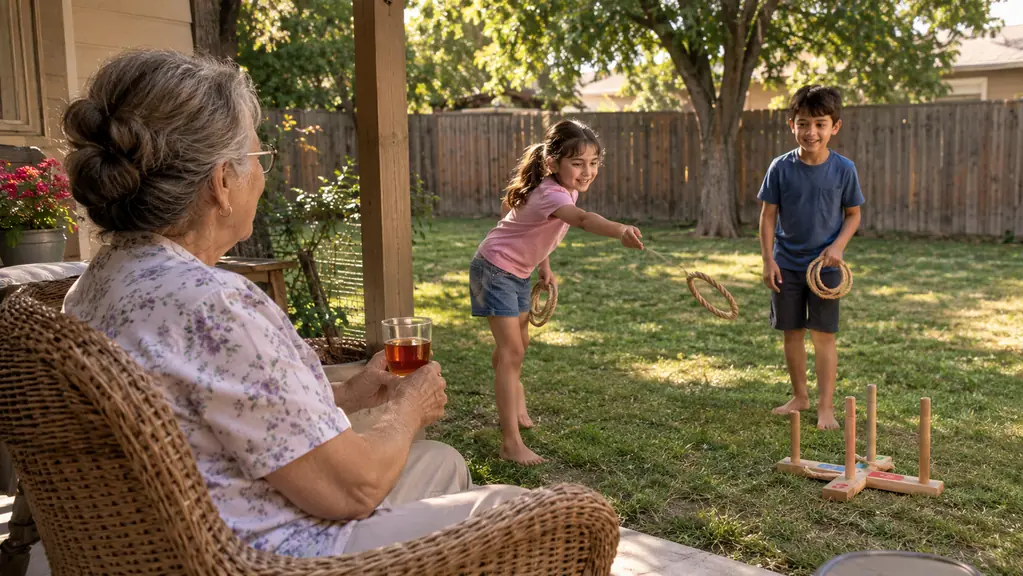
Mason turned five in the spring and he has exactly one speed, which is full. By nine in the morning he has been out the back door twice. By ten he is looking at me like the house is a personal insult. So I have spent the last few summers buying outdoor games and then watching, honestly, which ones get used twice and which ones get used all summer. The Elite Sportz Ring Toss has been in the rotation for three summers now. Cornhole has come and gone, mostly because Ray likes it, and mostly in the cooler months when nobody wants to be running.
Here is the short answer before the long one. With small grandchildren and a yard that is more patio than pasture, ring toss wins and it is not close. With older kids, a long flat lawn, and grown-ups who want to play too, cornhole is the better game. They are not really competing for the same afternoon, which is why I keep both, and why I have an opinion about which one you should buy first.
| Elite Sportz Ring Toss | Cornhole | |
|---|---|---|
| Setup | Base out of the bag, set on the grass, ready in under a minute. | Two boards, eight bags, and a decision about whether the grass is dry enough to drag them across. |
| Footprint | The base is listed at 16.54 by 1.97 by 0.71 inches. It fits in a small yard and stores behind a door. | Needs a long lane, roughly 27 feet between boards for the standard game. |
| Who can play | Plays up to five, so three grandchildren and two adults can be on it at once. | Two at a time in standard play, which means a small child waits a long while between throws. |
| Portability | The whole set is 2.2 pounds. One hand, one trip to the car. | Bulky and heavy. Usually a two-trip job just to get it into the driveway. |
| Rainy day use | Moves to the end of the hallway or the covered porch with a softer toss. | Not an indoor game in any real sense. |
| Toddler safety | Rope rings are soft and light, and there is nothing tall to pull over. | A board can tip if a small child climbs on it, and a thrown bag can catch someone in the face. |
| Movement | Kids stay in a small circle taking short walks to gather rings. | Constant walking back and forth across the yard. More steps, more often. |
| Grown-up appeal | Fine to play, but most adults read it as a children's game. | Adults will actually join in and keep score without being asked twice. |
| Challenge for older kids | A rope ring is forgiving. A lucky toss still lands, which is good at five and boring at ten. | Bean bags reward a steady, repeatable throw. More satisfying the older and more competitive the child. |
| Rough handling | Wood base and rope rings hold up to normal play, though a hard stomp or a drop onto concrete can crack the base. | Heavy boards and stitched bags shrug off weather and teenagers. |
| Counting practice | Score markings on the base get kids adding out loud without being told to. | Standard rules and cancellation scoring ask more of an older child. |
| Storage | Slides into a closet corner or behind a door. | Takes a shelf or a stretch of garage wall. |
Where the Elite Sportz Ring Toss Wins
The first difference is setup, and the gap there is wider than people expect. The Elite Sportz set is a wooden base with score markings and five rope rings. It weighs 2.2 pounds in total, and the base measures 16.54 by 1.97 by 0.71 inches, which is the reason it lives behind my laundry door instead of in the garage. I carry it out with one hand while holding a cup of coffee in the other. Cornhole is two boards and eight bags and a certain amount of grunting, and Ray has to be in the mood to do it.
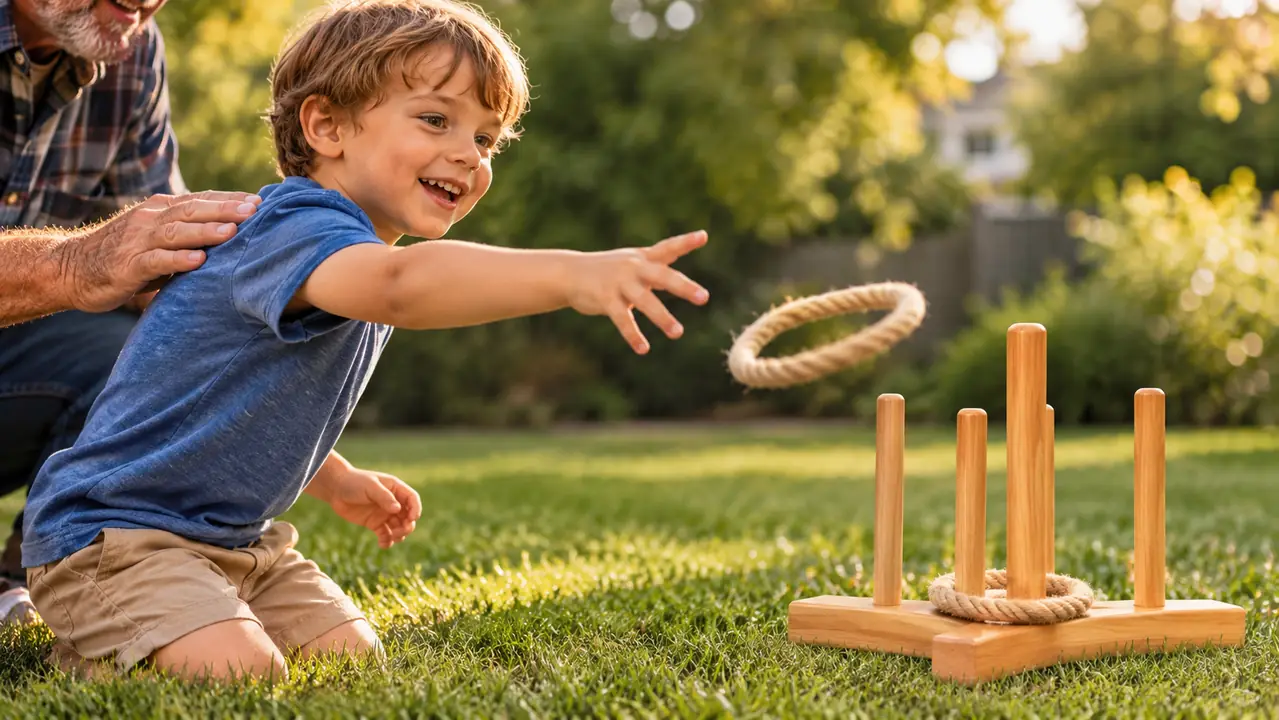
The second thing is who can be on it at the same time. The set plays up to five, and I have had all three grandchildren plus Ray on it at once without anyone standing around waiting. Owen, who is two and puts everything in his mouth, stands about three feet from the base and drops a ring down onto it. He believes he is winning. He is winning, honestly, because he is outside and moving and nobody has handed him a tablet. With cornhole, Owen cannot throw a bean bag 27 feet, so he stands next to a board and gets moved along every few minutes.
The score markings on the base do more work than I expected them to. Ellie counts out loud without being asked. Mason has started adding two rings together without realizing he is doing arithmetic in July. On a wet afternoon I set the base at the end of the hallway and the children toss from the kitchen doorway. It is a quiet game, nothing in the set needs batteries, and there is nothing to charge or lose in the couch cushions, which around here counts as a genuine feature.
Before I bought the Elite Sportz set, I tried a homemade version, because I am a nurse and I have a habit of thinking I can solve a problem with what is already in the garage. I cut five rings out of an old garden hose and set them over a tomato stake. It worked for exactly one afternoon. The stake tipped over every time a ring hit it, the rings rolled under the porch, and by the second day Mason had lost interest and gone back to throwing a ball at the fence. The difference is the base. A wooden base with score markings stays where you put it on the grass, and the rings are rope, so they land and stay land instead of bouncing off into the bushes. The set is also light enough that I do not mind carrying it out and back. That sounds like a small thing. It is the whole thing. The game that is easy to set out is the game that gets set out. I have carried heavy games out to the yard exactly once and then left them in the garage for a year.
Where Cornhole Wins
Now the part that stings a little. Cornhole moves a child more. A regulation lane runs 27 feet from board to board, so a kid walks up, throws, walks back, throws again, and keeps doing it for an hour. Mason will make a hundred small laps of the yard without noticing he is exercising. Ring toss keeps everyone in a small circle. A child who needs to empty a full tank of energy will get more of that from the boards, and I will not pretend otherwise just because I like the other game better.
Cornhole also carries a grown-up gravity that ring toss does not. Ellie is seven and she likes the weight of a bean bag in her hand and the thud it makes when it lands on the board. Ray will join a cornhole game and keep score and start talking strategy, which he has never once done over a rope ring. The boards and stitched bags take a beating that a light wooden base would not survive, and that matters in a family where children flop down on whatever happens to be lying on the lawn. The rules ask more of the older kids too. Partners and cancellation scoring mean they hold numbers in their heads and work with somebody else, and that is a step beyond tossing a ring, counting to five, and running to fetch it.
The summer Mason was four, Ray set the boards out at the full distance and Mason threw from halfway. Even from halfway the bag was too heavy for him and landed short six times in a row. He handed it back to Ray and went to the ring toss, and I did not blame him. Cornhole also needs a dry flat lane. After a rain the boards sit in the garage for two days because the grass is soft and the boards slide. Ring toss gets played on wet grass, on the porch, and in the hallway. So cornhole wins on movement, and it loses on availability. A game that only comes out when the weather is right and the grass is dry is a game that a five-year-old stops asking for. I keep the boards because Ray likes them and because Ellie is getting older. I do not keep them because they get used every weekend. That is the honest trade, and I would rather say it out loud than pretend the game I like better wins every column.
Owen is two, he stands three feet from the base, and he drops a ring onto it. That is the whole argument for ring toss in one sentence.
The game that comes out for ten minutes and stays out for an hour
Five rope rings, one wooden base with score markings, 2.2 pounds, and room for five players. It is the one I reach for when the grandkids are small and the afternoon is short.
Amazon Check Today's Price on Amazon →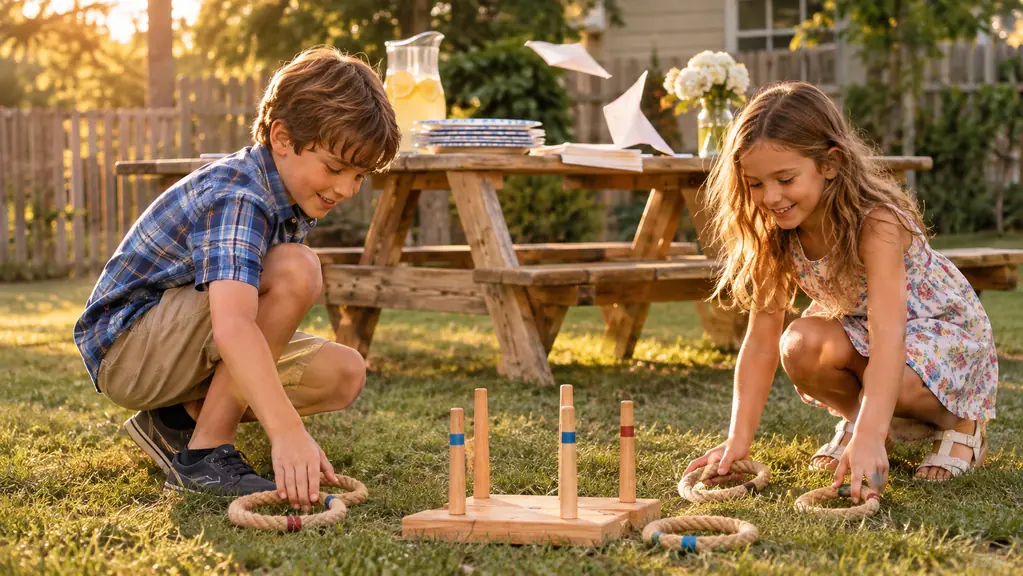
What a Saturday Afternoon Actually Looks Like
Last Saturday went like this. Ellie got the chalk out and started a scoreboard on the patio, which is her version of organizing a sport. Mason announced he was throwing from the far fence, missed nine times, and then moved closer without admitting he had moved closer. Owen picked up a ring and put it in his mouth and I took it out, which is the one thing I still have to watch with him. Rope rings are soft and light, and the base is low to the ground, but a two-year-old will chew on anything and a rope ring is not a teether.
Ray brought the cornhole boards out around three, when the shade finally reached the far end of the yard. Ellie and Mason played two rounds with him and then drifted back to the ring toss. I think that happened because the ring toss lets all three of them play at once and nobody has to be the one waiting. Cornhole is a two-at-a-time game, and a five-year-old waits a long time between throws. That is the pattern I have watched all summer. The boards come out for Ray. The ring toss stays out for the children.
The other thing I notice is who wanders over. Neighboring kids drift toward the ring toss because they can figure it out in one throw and they are in the game immediately. Cornhole draws the adults and the older children. If your measure of a good toy is how many kids of different ages can be on it at the same time without an argument breaking out, ring toss wins that one going away.
I kept a tally one Saturday, mostly because I wanted to know if my impression was right. In twenty minutes Ellie made thirty-four tosses, Mason made forty-one, and Owen dropped twelve rings onto the base from three feet away. Nobody had to wait for a turn. When Ray brought the cornhole boards out at three, Ellie and Mason played two rounds and then came back. I timed the gap: Mason threw his last bean bag at 3:40 and was back at the ring toss by 3:46. That is not a knock on cornhole. It is a fact about a five-year-old's patience. Cleanup took one trip. I stacked the five rings over the base and carried the whole thing inside with one hand while holding the screen door open with the other. The cornhole boards took Ray two trips and a fair amount of muttering. I have done that tally three summers running and the pattern has not changed.
What I Liked
- Sets up in under a minute on grass, porch, or hallway floor
- Five rope rings means three grandchildren and two adults can play at once
- At 2.2 pounds the whole set goes to the park in one hand
- Score markings on the base get kids counting without being nagged
- A two-year-old can stand close and still land a ring
Where It Falls Short
- Too easy for children past about nine, who lose interest quickly
- The wooden base is light, and a hard stomp or a fall onto concrete can crack it
- Rope rings can be swung around, so a toddler still needs an adult nearby
- It does not tire out a high-energy child the way a running game does
Who Should Buy Which
Buy the Elite Sportz Ring Toss first if your grandchildren are under about eight, if your yard is small or mostly patio, if you want something that goes in the car to the park, or if you want a game a toddler and a second grader can play together without a grown-up refereeing every single throw. It is also the one I would pick for a grandparent who is not going to haul heavy boards out of a garage and back again. It is the game that gets used on a Tuesday, not just at a cookout.
Buy cornhole if the children are nine or older, if you have a long flat lawn and a grown-up who wants in, and if you want a game that tires a child out rather than entertaining them in place. For a family with a wide age spread and a big yard, cornhole will get more years out of the older kids and ring toss will get more use out of the younger ones. Both answers are honest. It comes down to who is standing in your yard on a Saturday.
If you are buying this as a gift and you do not know the child's exact age, ring toss is the safer bet. A two-year-old can play it with help and a seven-year-old can play it without any, and neither one needs a grown-up to set up a lane or measure a distance. That is not true of cornhole. I have watched a grandparent buy cornhole for a four-year-old and then spend the afternoon moving the boards closer and closer until the child was throwing from three feet and still losing interest. The ring toss does not have that problem because the distance is whatever the child can manage. Owen stands close. Mason stands at the fence. Ellie stands in between and keeps score. One set handles all three without an adult adjusting anything. That is what I would want somebody to tell me before I spent an afternoon carrying boards.
Start with the one a two-year-old can play
Five rope rings, one wooden base with score markings, room for five players, and 2.2 pounds carried in one hand. If the grandkids are small, this is the game that gets used before the boards ever come out of the garage.
Amazon See the Ring Toss on Amazon →