

My husband Ray and I keep the spare bedroom set up for the grandchildren, and the closet in that room has become a museum of toys that looked better in the listing photo than they did on the living room floor. So when I say I was skeptical about a hundred pieces of magnetic plastic, I mean it. I bought the PicassoTiles 100 piece set for Ellie's seventh birthday, mostly because she had played with a friend's set and would not stop talking about it. What I did not expect was that Mason, who is five and would rather be outdoors, would end up using it more than she does.
This is the honest version of that review. Not whether the tiles are nice, because they are nice. Whether they hold up to three children of different ages, whether the age label on the box means anything, and what a grandparent should know before buying a set this size. I am not going to tell you a hundred small plastic shapes changed our lives. I am going to tell you where they earn their shelf space and where they end up in the bottom of the bin with the pieces scattered.
The Quick Verdict
A genuinely good building toy with one hard limit: the manufacturer's age label. Buy it for the five and up crowd and keep the two year old clear of it.
Amazon Check Today's Price →If your grandchild has stopped putting things in their mouth, start here.
A hundred magnetic tiles that need no batteries, no sounds and no screen. The listing below carries the manufacturer's age guidance and today's price.
Amazon Check Today's Price on Amazon →How I've Used It
The box measures about fourteen inches by eleven and a half by three, and it weighs five and a half pounds. That number matters more than it sounds. A hundred pieces at that weight means each tile has some substance to it, and it means the box is heavy enough that a seven year old carries it with both hands and asks for help.
We have had the set for about eight months. It has been on the kitchen table, out on the covered porch, on the floor of the spare bedroom, and once near the bathtub, which I stopped. It has been stepped on, sat on, and dumped down the hallway. Nothing has cracked. A few tiles have picked up surface scratches, which is what happens to plastic that lives on a floor, and I do not count that against it.
What I did not anticipate is how quiet the play is. There are no batteries in this set and no sounds. Operation is manual, according to the listing, which means nothing beeps, nothing lights up, and nothing needs charging. For a grandmother trying to get three children off screens for an afternoon, that is most of the value right there. The PicassoTiles set earns its place for that reason alone.
Cleaning is easy, which matters more at my age than it used to. A damp cloth takes care of whatever the tiles pick up, and I have not had to do anything beyond that. They have been out on the porch a dozen times and come back in looking no worse for it.
What Is in the Box, and What the Numbers Actually Mean
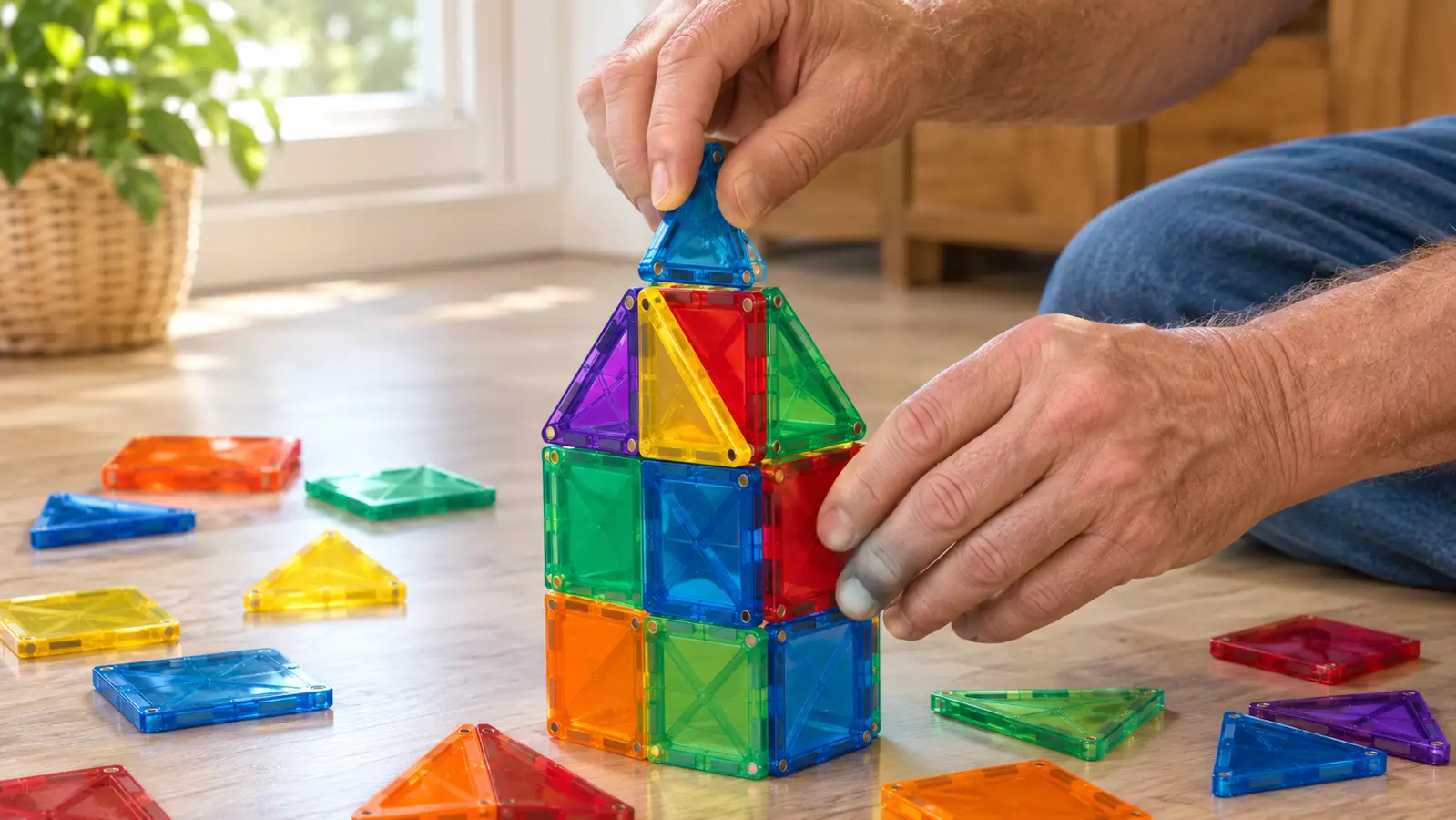
A hundred pieces is the headline and the count is accurate, but the number will not mean what you expect it to mean. If a child wants to build something tall enough to walk behind, most of the set goes into that build. Ellie's best tower used somewhere around seventy pieces and left the rest in a pile she could not do anything else with. That is the honest math. Two sets is what a serious builder wants. One set is a good start.
There is an instruction manual in the box. It is thin, and it does what manuals for toys like this always do, which is show a dozen ideas and then stop. The ideas are fine. They are not why anyone plays with the tiles. Within an hour of the first open, Ellie had stopped looking at the manual entirely and was building things the booklet never suggested.
The listing describes geometric shapes and 3D forms, and it mentions counting and shape work. I would not buy this as a math toy. I would buy it as a building toy that teaches a little without announcing that it is teaching. You will not see a lesson happen. You will see a child work out that two small pieces cover the same space as one large one, and then never mention it again.
The Age Label Is the First Honest Thing About It
The manufacturer recommends three years and up. Owen is two. I want to be plain about this. I do not let him play with these, and I would not let him play with any magnetic tile set at his age, whoever makes it. The tiles are small enough to go in a mouth, and the magnets are inside them. Thirty four years in labor and delivery taught me what happens when a small swallowed object turns into a surgical case, and I am not willing to take that chance in my own living room.
That is not a knock on PicassoTiles. I would say the same thing about the set Ellie's friend owns. The label is doing its job. I am writing it down because the label is easy to wave off when you are buying a gift for a house with a baby in it, and it is the one line on the box I would want a grandparent to read twice.
Owen does get to be part of it, in a way. He sits on my lap and hands me tiles while I build, and then he knocks the build down, which he finds funnier than anything else in his day. He is included without having his mouth anywhere near a tile. That compromise works here because Ray or I am always sitting right there. If you are buying for a home where the two year old is often in a room with the older children and no adult, wait a year.
A hundred pieces sounds generous until a seven year old builds one tower and uses seventy of them.
How Three Different Ages Play With the Same Hundred Pieces
Ellie is seven and would rather craft than do almost anything else. She builds with intent. She sorts the pieces before she starts, which I did not teach her. She has made a house with a door that opens, a garage for a small car, and a tower she insisted stay up for four days on the end of the kitchen counter while the rest of us walked around it.
Mason is five and mostly wants to be outside. He does not build so much as launch. He stacks pieces as high as he can get them and knocks them down and starts again. What surprised me is how long that holds him. Twenty minutes is a long stretch for Mason. On a rainy Saturday in the fall he played with this set for close to an hour and I never had to mention screens once.
The best thing the three of them built together was a road. Ellie laid it out, Mason drove a small truck along it, and Owen sat at the far end and put a tile back down every time it came loose. It ran most of the length of the kitchen and stayed up for two days. None of them would have done that alone.
Owen is two and is not the audience yet. But he is the reason the set lives on a shelf with a door on it instead of in an open bin on the floor. The three of them together on a Sunday afternoon is the picture I had in my head when I bought it, and most Sundays it is roughly what happens.
What Nobody Tells You Before You Buy
Nobody tells you how loud a hundred plastic tiles are when they come out of the box. That is my smallest complaint and the one I repeat most often. Ray says it sounds like a drawer of dishes falling. He is not wrong.
Nobody tells you that one set will not build a whole castle, only part of one, and that a child who has seen a big castle built online will be flat about the result the first time. Manage that before the box opens. Ray built the first tower with Ellie and it was modest, and she lost interest until he suggested they build a road instead, which used pieces up and covered more floor and made her happy.
Nobody tells you about hard floors. A hundred smooth plastic tiles on hardwood is a slip hazard, and I am sixty seven. We put a blanket down now, every time, and that solved it.
The listing shows four point eight stars from more than forty thousand buyers, which is a lot of people saying the same thing. What those ratings cannot tell you is which age the buyer had in mind. Four point eight stars from a house with a five year old and four point eight stars from a house with a two year old are not the same review.
Nobody tells you that you will end up being the one who builds the tall part. Small hands can place the lower pieces but they cannot always reach the top, and I have been asked to be the crane more times than I can count. My knees have opinions about this. A low table helps more than any advice I could give you.
And nobody tells you the good part, which is that this is a toy an adult can build with, not just watch. You are not required to pretend. You are actually doing the thing alongside them. Ray and I have both sat on the floor for an hour with Ellie and Mason and not once looked at a clock. That is rarer than it should be.
What I Liked
- No batteries, no sounds, no screen, and nothing to charge
- Holds the attention of a seven year old and a five year old differently, so it covers more than one age
- The tiles have real weight to them, and eight months of being stepped on and dumped has not cracked one
- An adult can genuinely build alongside a child rather than sitting and watching
- Operation is manual per the listing, so it works on a porch, in a car, anywhere
Where It Falls Short
- The three years and up label rules out the two year old entirely, and that is the correct call
- One hundred pieces will not build the castle a child has in their head
- The included instruction manual is thin and shows only a handful of ideas
- Loose tiles on hardwood are a slip hazard for older knees and hips
- It does not stay contained, and one or two pieces will live under the sofa
Keeping Track of a Hundred Pieces
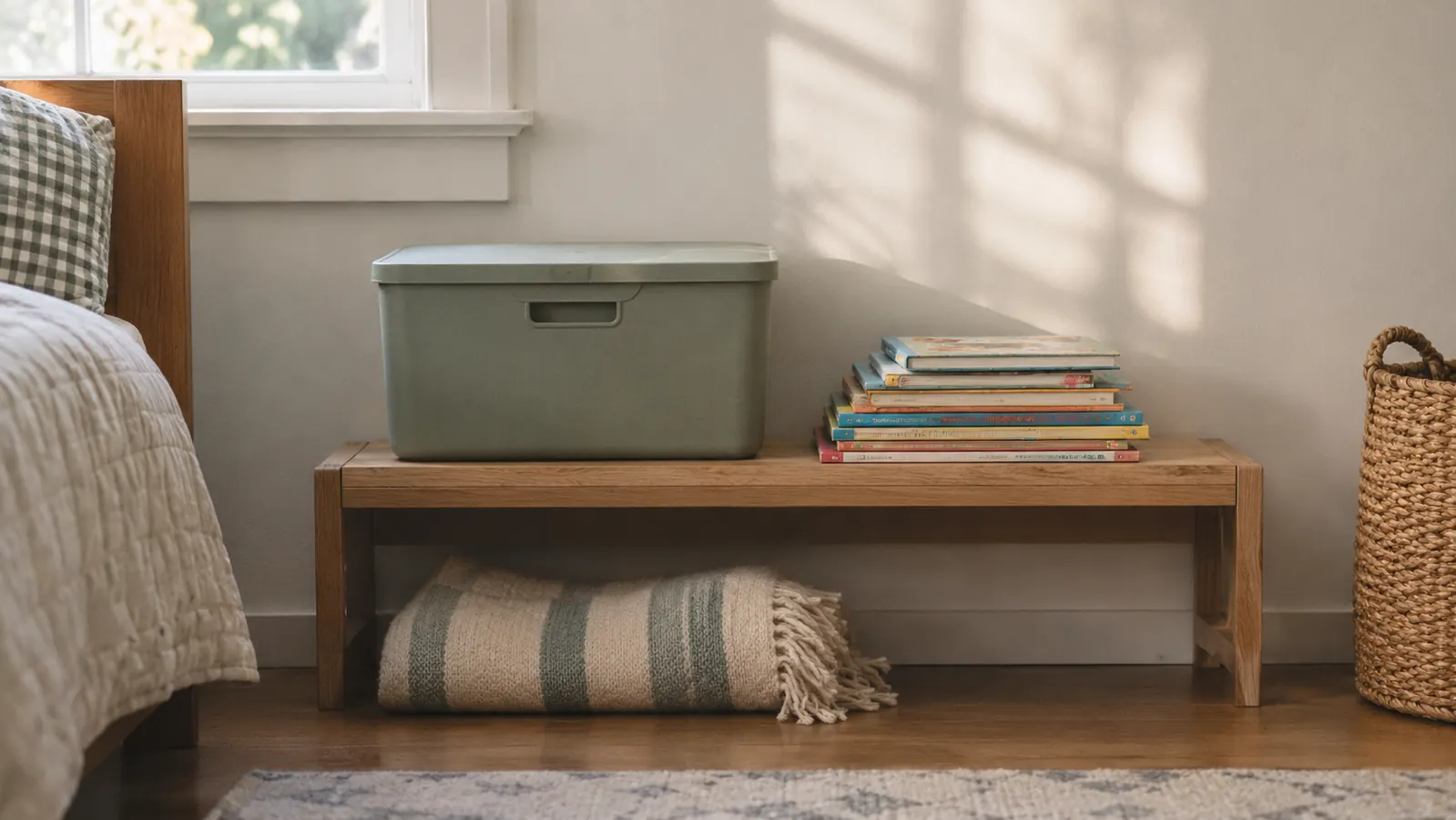
A hundred pieces is a hundred pieces, and they do not stay in one place. The first month we kept them in the box they came in, which is fine until the box is empty and the lid is somewhere else. The second month Ray brought home a lidded storage bin from the hardware store, and that is what we use now. It lives on a low shelf in the spare bedroom behind a door, which is the only reason Owen does not get into them.
Sorting is not something I do. Ellie does it, and she is better at it than I am. She has decided the pieces go by size and not by anything else, and if I put one back in the wrong place she notices. That is her project and I leave it to her. If your grandchild is not a sorter, the tiles will live in one bin in one pile, and that is fine too. Nothing about this set requires order.
We have lost two pieces in eight months. I found one under the refrigerator and one in the cushions of the porch swing, which tells you something about where this toy actually gets used. Neither loss has mattered. Two out of a hundred is not a problem. Losing thirty would be, so keep an eye on the bin when the children carry it outside.
The Things I Would Change If I Could
I would print the age guidance on the front of the box in larger type, because it is the thing that matters most and the thing easiest to miss in a birthday hurry. I would also put a mesh bag in with the manual so a family has somewhere to put the pieces on day one, instead of improvising for a month the way we did.
I would make the manual longer, or at least put a few builds in it that use most of the set. A picture of a small tower does not tell a child what a hundred pieces can do. A picture of a castle that eats seventy of them would.
And I would tell buyers plainly that one set is a starting point. The set is good. It is not a whole building program. Knowing that in advance would have saved one disappointed face at a birthday table, and it is the sort of thing a listing cannot say about itself.
Who This Is For
This set is for a child of three or older who likes to build, and for the adult who wants to build with them. It works especially well in a house where children of several ages visit, because the play changes with the age rather than needing three separate toys taking up three separate shelves.
It is also for the grandparent, if I am being honest. The hours I have spent at the kitchen table with Ellie, handing her pieces and being told I am doing it wrong, are the best hours of my week. A toy that gets me sitting down beside her instead of across the room from her is worth the shelf space it takes up.
Who Should Skip It
Skip it if there is a child under three in the house who will be in the same room. Skip it if your grandchild has no patience for building and would rather be running, because no amount of magnetic tile will change that. Mason surprised me, but that is not a promise I can make on your behalf.
And skip it if you want a gift that stays contained. A hundred pieces do not stay contained. If the parents need a toy that goes back into one tidy box at the end of the day, this is not that toy. It does go back in the box, but it takes a while, and one or two pieces will live under the sofa for a month before anyone notices.
Buy it for the five year old. Wait a year for the two year old.
A hundred magnetic tiles, no batteries, no sounds, no screen. The manufacturer's guidance is three years and up, and that line on the box is the most useful thing on it. Listing details and the current price are through the link below.
Amazon Check Today's Price on Amazon →