

The first time I dumped a hundred magnetic tiles on the rug for all three grandchildren at once, it lasted about nine minutes. Ellie, who is seven, started a house with a real plan. Mason, who is five, knocked a corner off it running past. Owen, who is two, put two tiles in his mouth. That was the whole afternoon.
So I changed how I do it. I stopped setting out the full set and expecting everyone to share, and started treating it more like a shift on the ward, where you match the task to the person and you keep the smallest one where you can see him. PicassoTiles is what lives in my spare bedroom now, the 100 piece set, and it has held up through two summers of this. Here is the method that actually works at my house.
One tin, three ages, and no arguing over whose turn it is
The 100 piece PicassoTiles set is what I keep on the shelf for weekends. Enough pieces for two builders to each make something real, and a manual in the box for the day a child asks how to build a roof.
Amazon Check Today's Price on Amazon →Step 1: Build on a hard floor, not carpet, and set a boundary
Magnetic tiles need a flat, firm surface to stand up straight. On a thick rug, a tower leans, the base shifts, and a child who did nothing wrong watches her work fall over. That is the fastest way to lose a seven-year-old's interest. We build on the wood floor in the front room, or on the back porch boards when the weather is decent.
Then I mark a boundary. I lay a bath towel down and say the tiles stay on the towel. Not because I am fussy, but because a hundred loose pieces spread across a whole room turn cleanup into a fifteen-minute job, and the child who is tired is never the one who picked them up. On the towel, Owen can sit at the edge and push pieces around without carrying them off, and I can scoop the whole thing up in one motion.
I tried a bedsheet first, and it was the wrong tool. The fabric bunched up under a tower and the whole thing listed to one side. A towel with some weight to it lies flat. Ours is an old dark bath towel, big enough to hold about forty pieces before things start spilling past the edge, and when the tin comes down off the shelf, the towel comes with it. That pair is the whole setup.
Nurse's note on the pieces themselves. The manufacturer's age label on this set is three years and up, and it is on there for a reason. Owen at two is not old enough for the set as sold. When he is on the floor with us, I hand him a couple of the larger flat squares to hold and turn over, I stay within arm's length, and the rest of the tin stays on the far side of the towel. It is not worth a scare to let him have the whole set early.
Step 2: Give each child a job that fits their age
The mistake I made for months was assuming everyone builds the same thing together. They do not, and trying to force it produces tears. One Saturday in March I asked all three of them to help me build a castle. Ellie wanted a tower, Mason wanted a ramp for his cars, and Owen pulled the same corner off twice. We finished nothing, and Ellie went and sat in the other room. That was the last time I asked for one shared project.
Ellie plans. She wants to know how many squares it takes to make four walls and whether the triangles will close at the top. I let her lay pieces flat on the floor first, in an outline, before anything goes vertical. That flat planning stage is where she does her best thinking, and it means fewer collapses later.
Mason is my colour sorter and my runner. He is not going to sit still for a roofline, so I give him something to fetch: bring me six of one kind, find every triangle, stack the small squares. He is moving, which is what he needs, and he is part of the build without being asked to be patient in a way he cannot manage yet. His jobs run in short bursts. He will fetch for four or five minutes, then he is out the back door, then back ten minutes later wanting to see what we made. I stopped calling him back in. The coming and going is not a problem to fix, it is just how a five-year-old works.
Owen gets a task too, because a two-year-old left out will simply take what he wants. His job is handing me pieces, one at a time, and putting them back in the tin when I ask. He is not building. He is participating, which is different, and it keeps the peace.
Step 3: Build low and wide before you build tall
This is the single change that saved the whole activity at our house. Tall towers are what children want and what magnetic tiles are worst at, especially in a room with a five-year-old moving through it.
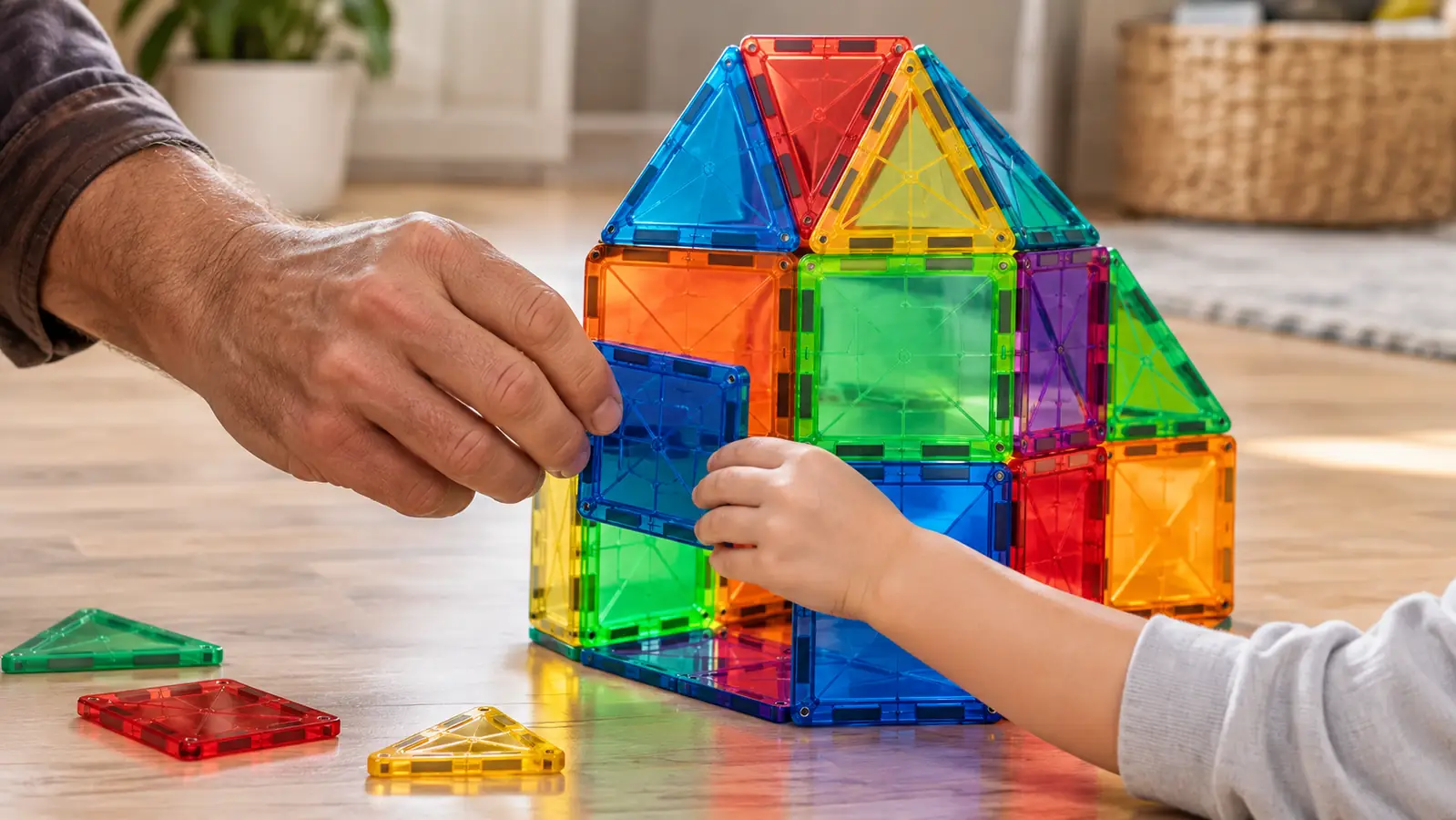
So we start with a house that is one or two pieces high, with a wide footprint. A floor plate of squares, walls two pieces tall, a triangle on top for a roof. It looks like a little ranch house, which is what we live in, and the children like that. It stays up. When someone bumps it, one wall slides and it can be fixed in ten seconds instead of rebuilt from nothing.
A wide base is the whole reason it survives. Six squares laid flat in a two by three grid will hold a wall far better than four squares in a single line, and a child can feel that difference in her hands long before she could explain it. I show Ellie once and then let her make the call herself, and she has made it wrong plenty of times, which is how she learned it.
Once the low build is standing and nobody has knocked it down for a while, then we go up. I hold the top while a child adds a piece. That is the whole trick. My hands are the scaffolding, and I am not doing the building, I am just steadying it so their work does not punish them. The tallest we got last June was eleven pieces. Ellie was setting the twelfth and her hand was shaking with the effort of not touching it. I held the base, she set the piece, and it stood about four seconds before Owen came around the corner. She laughed. Two summers ago she would have cried.
The tiles stick on the edges by magnet, so a corner has to line up reasonably well or it will pull loose. That is a real skill and it takes young children a while. Do not fix it for them. Let them feel the pull and turn the piece. It clicks into place and their face changes.
Step 4: Take turns being the one who decides
The fights in my house are almost never about pieces. They are about whose idea gets built.
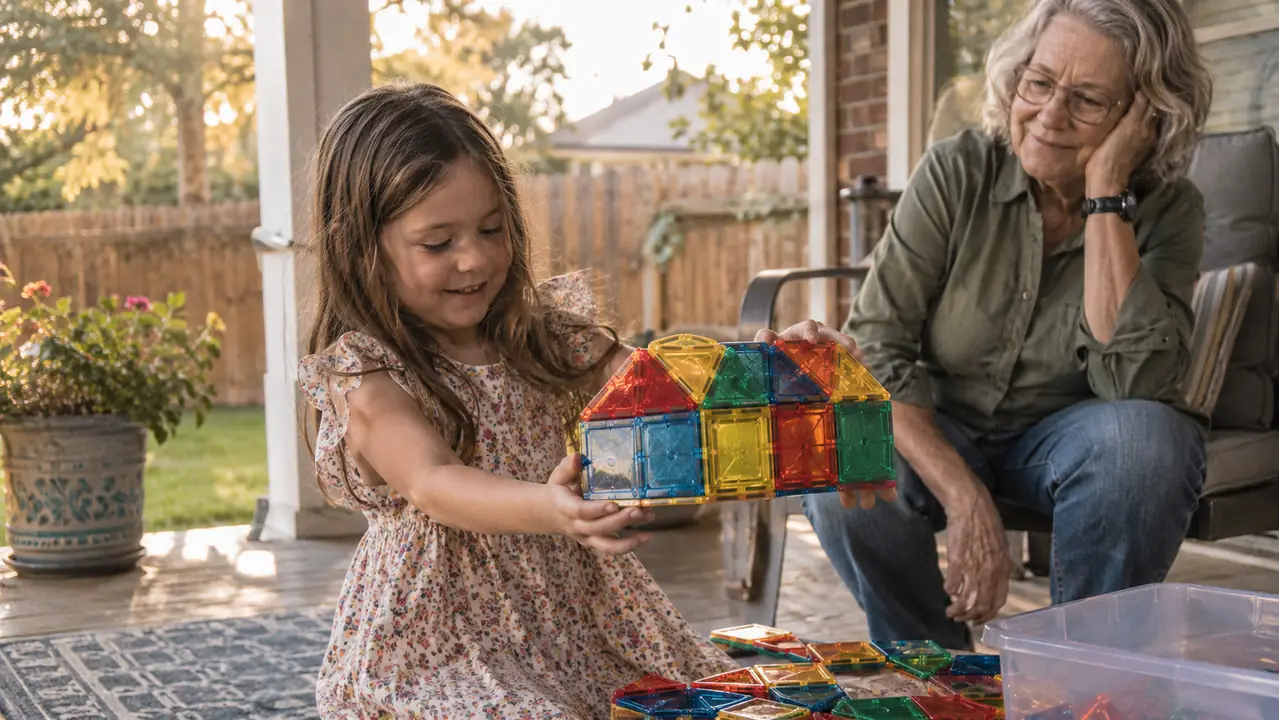
My fix is a rotation. Ellie gets to direct for a while: she says what we are making and the rest of us follow. Then Mason directs, and his ideas are different, usually lower and faster and involving a garage. Then it comes back around. It sounds small. It changes everything, because each child gets a stretch of time where the adults and the other children are on their side.
I take a turn too, and I deliberately build something bad. A lopsided shed. A roof that does not fit. The children correct me, which they love, and it teaches them that the rebuilding is the normal part, not a failure. That lesson is worth more than any structure we have ever finished.
The fights are almost never about pieces. They are about whose idea gets built.
Step 5: End on a win, and put the pieces away together
Children do not stop well. I learned this raising their mother and I have not forgotten it. So I give a warning before the end: two more pieces each, then we finish. Ending on a finished thing, even something small, is far better than ending on a collapse.
Then we put them away together, and this part matters more than it sounds. The set comes with a manual in the box and I keep that manual in the tin, because the children use it as a reference for shapes, not as instructions. The tin goes back on the shelf, and the floor is clear before anyone goes to the kitchen for a snack.
One honest word about the tin itself. A hundred pieces weigh a little over five pounds, which is fine for me to lift onto a shelf and awkward for a small child to carry across a room. I do not let the children haul it. It stays where I put it.
What Else Helps
A few things I have picked up that are not steps, exactly, but they make the difference between a good hour and a short one.
Keep the set available but not out. When the tiles live permanently on the floor, they lose their pull. When they come down off the shelf on a Saturday morning, they are an event. I have watched the same children ignore a full bin of toys for a week and then spend an hour with the same bin the moment it is brought out fresh.
The tin measures about fourteen inches by eleven and a half by three, so it slides onto the spare room shelf beside the board games without needing a shelf of its own. That is a smaller thing than it sounds. A toy that needs its own storage spot is a toy that ends up out in the garage, and we all know how that goes.
Get down on the floor. Not beside them on the couch, giving directions. On the floor, with your knees complaining. Children build longer when an adult is building too, and it is also the only way I can see what is happening with the smallest one's hands.
Let the build stay up overnight, if there is somewhere safe to leave it. Nothing deflates a child faster than finishing something and watching it get swept away before bedtime. We leave whatever is standing on the low table in the spare room and come back to it the next morning.
One more that costs nothing. I keep a short list in my head of what each of them built the last time they were here, and I ask about it the moment they walk in. Ellie's house with the triangle roof. Mason's garage with no door. Owen's stack of squares he carried around the yard. It takes ten seconds and it tells them I was paying attention.
And take the outside option when the weather allows. Ray and I have carried the towel and the tin out to the back porch more than once. It is the same activity with fresh air and a lot more noise, and Mason stays with it twice as long outdoors. If a toy can get a five-year-old building and moving at the same time, it earns its spot on the shelf.
If you want the longer view on how this particular set has held up across years rather than one weekend, there is a full long-term write-up, along with a side-by-side against the brand most people compare it to. The short version is that the pieces have taken real abuse and the magnets are still doing their job.
The tin I keep on the shelf for weekend visits
A 100 piece PicassoTiles set, age labeled three and up, with a manual in the box and enough pieces for two children to build at once. It is the toy that gets pulled down most often at our house.
Amazon Check Today's Price on Amazon →